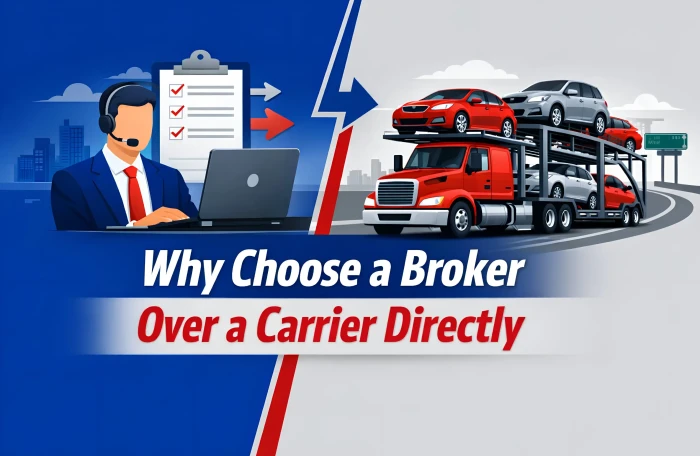


Working directly with a carrier sounds like the simplest route. You find a company with a truck, agree on a price, and move forward. That assumption breaks down once you see how the car shipping market actually operates.
The U.S. trucking industry is highly fragmented. Most carriers are small operations, often running only a few trucks. In fact, more than 90 percent operate fleets with 10 or fewer vehicles, which limits how often they serve certain routes and how flexible their schedules can be.
This matters more than most people expect. If your route does not align with a carrier’s existing schedule, you may face delays or need to start over with a different company. A broker exists to solve that problem by connecting you to a wider pool of carriers that can match your timing and route.

The Industry Isn’t Built for One-Carrier Access
Most carriers are not structured to serve individual customers across every route. They operate within specific lanes that make sense for their equipment and driver availability.
That fragmentation is well documented. The majority of carriers are small businesses without nationwide reach.
If you contact one carrier directly, you are seeing one version of availability. If that carrier cannot meet your needs, you either wait or repeat the process elsewhere.
A broker simplifies that process by aggregating access to those smaller carriers. Instead of managing multiple conversations, you work through one point that already has those relationships in place.
Federal Regulation Adds Structure and Accountability
Brokers operate under a defined federal framework. Under federal law, a broker is required to arrange transportation while remaining distinct from the carrier performing the move.
They must also keep detailed transaction records, including carrier information, shipment details, and compensation.
That level of documentation creates traceability. If something goes wrong, there is a clear record of who handled each part of the shipment. Direct carrier arrangements typically do not provide that same structured oversight.

Financial Safeguards Are Built Into Brokerage
Every licensed broker must maintain at least $75,000 in financial security through a bond or trust fund.
This requirement protects both customers and carriers if financial obligations are not met. It also acts as a barrier that prevents underqualified operators from entering the market. When working directly with a carrier, there is no equivalent financial safeguard layered into the transaction.
Vetting a Carrier Is More Complex Than It Looks
Verifying a carrier involves more than confirming they are licensed. It requires reviewing safety data, insurance coverage, and operational history.
Brokers monitor these factors continuously using federal safety systems and industry tools.
They also verify insurance directly with providers to ensure coverage is active and accurate. Without that process, you are responsible for identifying risks that are not always visible at first glance.
Claims and Liability Are More Involved Than Expected
Under federal law, carriers are responsible for loss or damage during transport through the Carmack Amendment.
That does not make the process easier for customers. It means you must manage the claim directly with the carrier, including documentation and follow-up.
A broker does not transport the vehicle but helps coordinate communication and guide the process if an issue arises. That support becomes valuable when timelines tighten or disputes develop. There is also a legal distinction that protects customers; brokers who clearly define their role as arrangers avoid being treated as carriers under liability law.

Fraud Is a Growing Concern in Shipping
Fraud and cargo theft have become significant issues across the logistics industry, costing billions each year.
One common tactic involves fraudulent carriers posing as legitimate companies using stolen credentials. Without experience, these situations can be difficult to detect.
Brokers invest in verification systems that cross-check carrier identity, authority, and contact details against official databases. That added layer helps reduce exposure to scams that continue to evolve.
Pricing Reflects Market Access, Not Just Fees
It is easy to assume that removing a broker lowers cost. That assumption overlooks how pricing actually works.
Carrier rates shift based on route demand, fuel costs, and available capacity. A single carrier provides one rate tied to their schedule.
A broker compares multiple carriers competing for the same route, which often leads to pricing that reflects current market conditions rather than one company’s limitations. There is also a time cost to consider. Contacting, evaluating, and coordinating with multiple carriers takes effort. For many people, that becomes the hidden cost of booking directly.
Flexibility Becomes Critical When Plans Change
Vehicle shipping rarely follows a fixed schedule. Weather, traffic, and route changes can affect timing. If you are working directly with a carrier and something changes, your options are limited to that company’s availability.
A broker can adjust by sourcing another carrier from their network. That flexibility reduces disruption and keeps the shipment moving.
How This Works with AmeriFreight Auto Transport
AmeriFreight Auto Transport operates as a licensed broker, focusing on coordinating shipments rather than operating trucks. The process centers on connecting customers with vetted carriers and managing the details from assignment through delivery.
You still make the final decision. No upfront payment until you choose a carrier. Door-to-Door Service (Location Permitting) is available depending on the route and carrier availability, using standard open or enclosed transport options.
The Questions Most People Are Already Weighing
Can one carrier realistically meet your timeline without delays?
Who helps resolve issues if something goes wrong?
How do you verify that a carrier is legitimate and properly insured?
Are you seeing the full range of available options or just one?
These questions often surface after a problem appears. Working with a broker addresses them before the shipment begins.
Where the Difference Becomes Clear
Direct carrier booking works best in predictable situations where routes and relationships are already established.
Most shipments do not fall into that category. Availability shifts, routes vary, and risks are not always visible upfront. A broker exists to manage those variables. Not as an extra layer, but as the structure that makes a fragmented industry workable for individual customers.