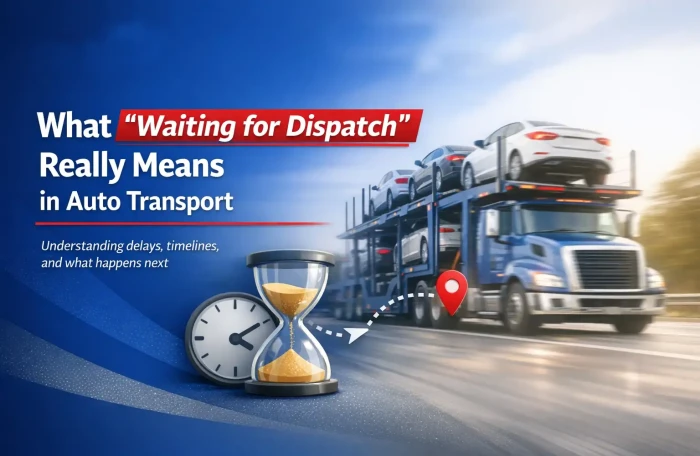


“Waiting for dispatch” is the stage in the car shipping timeline where your vehicle is fully listed but has not yet been assigned to a car carrier.
At AmeriFreight Auto Transport, this begins once your order is placed and prepared for the marketplace. AmeriFreight operates as an auto transport broker, acting as the agent that connects your shipment with a qualified carrier.
From there, your vehicle is posted to load boards such as Central Dispatch, a platform that has operated since 1999, where carriers search for available shipments. At this point, your vehicle is visible to carriers, but none have accepted it yet.
This is where most of the real coordination happens, even if it feels like nothing is moving. Understanding this phase helps set realistic expectations about timing, pricing, and availability, so you can make informed decisions rather than assuming delays or issues with your shipment.

Your Car Is Not in Line: It Is Competing
Your shipment is not waiting for its turn. It is being evaluated alongside many others. Carriers search load boards by route, vehicle type, distance, and payout. They are building efficient routes, not processing orders sequentially. Each decision is based on how well a shipment fits into an existing plan.
Trucking accounts for roughly 72.5 percent of all freight moved within the United States. Small carriers with 20 or fewer trucks account for 97% of the industry. That structure creates flexibility, but it also means routes are constantly shifting. A driver may adjust plans daily depending on what loads are available.
If your vehicle aligns naturally with a carrier’s route, it can be assigned quickly. If it requires extra miles or disrupts timing, it may remain in the waiting phase until the right match appears.

The Price-to-Speed Reality Most People Underestimate
Dispatch timing is closely tied to how competitive your shipment appears in the market. Carriers evaluate each listing based on how well it fits their route, schedule, and operating priorities. If a shipment aligns easily with their plan, it is more likely to be accepted quickly. If it requires adjustments or added effort, it may take longer to secure a match.
This creates a constant balance between price and speed. There is no fixed rate that guarantees immediate dispatch, since every decision depends on current demand, route availability, and timing. In practice, a shipment's market positioning plays a major role in how quickly it moves from waiting for dispatch to being assigned.
Why FMCSA Hours of Service Quietly Slow Things Down
Even when a carrier is interested, federal regulations can delay assignment. Drivers operate under FMCSA hours-of-service limits. They have a 14-hour on-duty window, with only 11 hours allowed for driving. After that, a mandatory 10-hour rest period applies. Over a week, they are limited to 60 or 70 total hours before requiring a 34-hour restart.
These limits affect availability in ways that are not visible. A truck may be near your pickup location but unable to accept a new load until the driver’s hours reset. Another may bypass your shipment because it does not fit within their remaining time. This is why pickup windows are shaped more by driver availability than by simple distance.

Distance Matters Less Than Route Density
Short distances do not always mean faster dispatch. Once a vehicle is on a truck, transit tends to follow a predictable pace, but the bigger variable is how long it takes to get assigned in the first place.
High-traffic routes tend to move faster because carriers can fill trailers easily. Less common lanes require more coordination, which can extend the time a vehicle remains in the waiting phase.
Deadhead miles, or traveling empty, are avoided whenever possible. If reaching your vehicle requires that kind of detour, it may take longer to attract a carrier.
Equipment Requirements Change Everything for Inoperable Vehicles
Vehicle condition directly affects dispatch timing. If a car cannot start, steer, or brake, it falls under inoperable vehicle transport. This requires equipment such as a winch or liftgate, which not all carriers have. If this condition is not disclosed in advance, a carrier may arrive unable to load the vehicle. The shipment then returns to the waiting-for-dispatch phase.
Loading time also changes. A standard vehicle is quicker and easier to load, whereas an inoperable one requires more effort and slows the overall process, which can limit how many vehicles a carrier can handle in a day. Additional charges are common in these cases, depending on the level of effort required.
Regional Pressure Points That Affect Dispatch Timing
Location introduces another layer of complexity. In California, emissions regulations and heavy port demand reduce carrier availability. Pickup windows often extend to 3 to 7 days or longer.
In the Northeast, narrow streets, low clearances, and seasonal weather can limit access for large carriers. In these cases, carriers may coordinate a nearby meeting point if direct access is not feasible. This aligns with Door-to-Door Service (Location Permitting), in which safety and legal access determine the exact pickup or delivery location.
These regional factors are common and can influence how long a shipment remains in the dispatch phase.

The Quiet Role of the Load Board Ecosystem
Load boards serve as the central marketplace where carriers and brokers connect. Platforms like Central Dispatch allow carriers to search for shipments that match their routes.
Shipments that align well with market expectations often receive quick responses. Others may remain available longer until a carrier can incorporate them into a route. Once a carrier agrees to the terms, a rate confirmation is issued. This is the point where the order is officially dispatched and assigned.
What Your Shipment Is Actually Waiting For
Your vehicle is not waiting for attention. It is waiting for alignment. A carrier must be available, operate within legal time limits, travel along a compatible route, be equipped for the vehicle type, and be willing to accept the agreed rate. All of these factors must come together at the same time.
Until that happens, your shipment remains active in the system and continues to be evaluated by carriers.
Where AmeriFreight Helps Move the Process Forward
“Waiting for dispatch” is not a passive stage, and this is where AmeriFreight Auto Transport plays an active role behind the scenes.
As an auto transport broker, AmeriFreight Auto Transport continually works to position your shipment to attract the right carrier. That includes reviewing market conditions, adjusting strategy when needed, and communicating with carriers to find a match that makes sense for both route and timing.
Customer service agents also help set clear expectations for your pickup window, explain when adjustments may be helpful, and present carrier offers for your approval. No upfront payment is required until you choose a carrier, which gives you control over whether to accept the terms or wait for a better fit.
When a carrier shows interest, we verify key details before dispatch, including registration and compliance standards, and issue the rate confirmation once everything aligns. If a carrier becomes unavailable, we work to find a substitute within the agreed-upon terms whenever possible.
The goal is not only to move quickly but also to match your shipment with a carrier that can realistically complete the job under the conditions of the route and schedule.