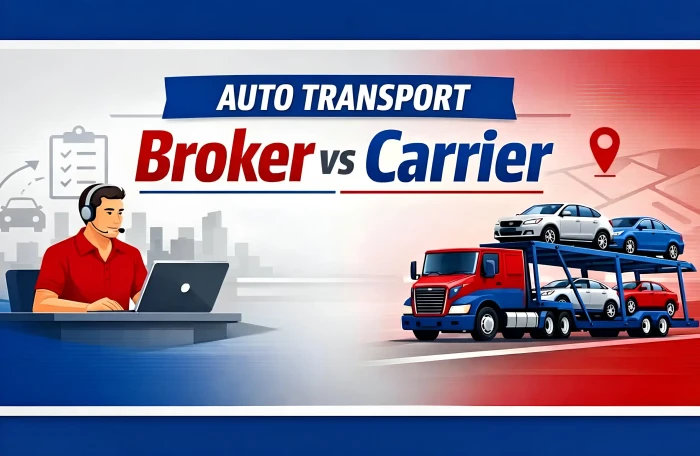


An auto transport broker vs carrier comparison sounds simple until you start getting quotes and asking who is actually moving your car. One company explains that it will arrange everything. Another says it operates trucks. At first glance, both seem to offer the same service, but they are handling very different parts of the process.
That difference shapes how your shipment is priced, how it gets scheduled, and who is responsible once your vehicle is in transit.

A Broker Arranges The Shipment While A Carrier Moves The Car
At the federal level, the distinction is clearly defined. A broker is a company that, for compensation, arranges transportation with an authorized motor carrier, while a motor carrier is the entity that physically transports the vehicle. These roles are outlined in 49 CFR § 371.2, 49 CFR Part 371, and FMCSA guidance such as the Small Entity Compliance Guide for Broker Operations.
This is not a technical detail that only matters to regulators. It determines who takes possession of your car and who remains responsible for moving it from pickup to delivery. The broker coordinates the shipment. The carrier handles the vehicle itself.
Many customers assume they are hiring the same company that will load their vehicle. In many cases, they are hiring a broker that will later assign the job to a carrier.
Why Brokers Exist In A Fragmented Carrier Market
The structure of the trucking industry explains why brokers play such a large role in car shipping. According to the FMCSA 2024 Pocket Guide to Large Truck and Bus Statistics and American Trucking Associations data, the vast majority of carriers in the United States operate small fleets, with more than 90 percent running 10 or fewer trucks.
That fragmentation means most carriers operate on specific routes rather than nationwide networks. A carrier based in one region may have no practical way to service a shipment that falls outside its lanes or schedule. When that happens, the carrier simply declines the job.
A broker fills that gap by working across a network of carriers. Instead of relying on one company’s routes, the broker matches your shipment with a carrier whose equipment, location, and schedule align with your needs.

What A Carrier Actually Handles During Transport
A carrier is responsible for every physical step of the move, from loading your vehicle onto the trailer to delivering it at the destination. That includes securing the vehicle properly, transporting it across state lines, and maintaining compliance with federal safety and insurance requirements.
Carriers must meet financial responsibility standards under 49 CFR § 387.7 and 49 CFR Part 387. Additional guidance from FMCSA, including insurance filing requirements and minimum coverage standards, explains the baseline coverage carriers must maintain.
Auto transport also requires specialized equipment. The American Trucking Associations’ autohauler overview highlights the use of purpose-built rigs designed to carry multiple vehicles safely and efficiently. These trailers are not interchangeable with standard freight equipment, which limits how carriers operate and where they can run.
Because of that, carriers prioritize routes that maximize trailer use and reduce empty miles. If your shipment does not align with those priorities, it may be difficult to secure space directly through a single carrier.

What A Broker Does Behind The Scenes
A broker’s work is less visible but often determines whether your shipment moves smoothly. The broker is responsible for sourcing available carriers, checking their authority and compliance status, and negotiating a rate that reflects current market conditions.
This role also includes coordinating pickup windows, relaying information between the customer and the carrier, and adjusting plans when schedules shift. The broker is not transporting the vehicle, but the broker is managing the process that leads to a successful match.
Brokers operate under their own regulatory requirements. They must maintain a $75,000 financial security instrument, typically structured as a BMC-84 surety bond or BMC-85 trust fund, as explained in industry resources such as Champion Risk’s broker bond overview and PFA’s BMC-85 explanation.
This requirement exists to protect against certain financial risks, such as non-payment to carriers. It does not cover damage to your vehicle, which remains the responsibility of the carrier during transport.
Pricing Differences Reflect Market Access, Not Just Markup
It is common to assume that working directly with a carrier will always result in a lower price. That assumption overlooks how pricing actually works in vehicle logistics.
Carriers price shipments based on their existing routes, available trailer space, and operating costs. If your vehicle fits neatly into a route they are already running, the price may be competitive. If it does not, the carrier may increase the rate or decline the job entirely.
Brokers operate across a wider marketplace. They can compare multiple carriers and adjust pricing based on supply and demand for a given route. The uploaded research indicates that typical broker margins often fall between 15 percent and 30 percent, with higher variation during volatile market conditions .
That margin reflects the coordination work involved in finding capacity, especially in a fragmented market where most carriers cannot serve every route.
Responsibility Becomes Clear When Issues Arise
The difference between a broker and a carrier becomes more important when something does not go as planned. If there is a problem with loading, transport, or delivery, the carrier is the party directly responsible for the vehicle, since it has physical possession.
If there is a breakdown in communication, scheduling, or carrier assignment, that often relates to the brokerage side of the process.
Federal rules reinforce this structure. Under 49 CFR § 371.3 and the corresponding eCFR section, brokers must maintain transaction records that document the details of each shipment. These requirements play a role in ongoing discussions about pricing transparency and broker practices, as outlined in analyses such as Holland & Knight’s review of broker transparency petitions.
Fraud Risk And Why Verification Still Matters
The broker-carrier structure also affects how fraud can occur in the industry. FMCSA highlights risks such as unauthorized operations, identity theft, and deceptive practices in its guidance on broker and carrier fraud and identity theft.
Consumers can review complaint processes and reporting tools through resources like the eligible complaints page, the National Consumer Complaint Database FAQ, and the NCCDB search portal.
The research document also points to ongoing concerns about double brokering, identity misuse, and limited pricing transparency within the market . These issues do not affect every shipment, but they are common enough that verifying company credentials and understanding roles is part of making a sound decision.
Registration Changes Are Reshaping How Companies Are Verified
The way brokers and carriers are identified is evolving. FMCSA’s Registration Modernization FAQs explain the shift toward a more unified system built around USDOT identifiers.
For customers, the implication is straightforward. Checking authority and status remains essential, even as the identifiers used to verify companies continue to change.
How AmeriFreight Auto Transport Approaches The Process
AmeriFreight Auto Transport operates as a broker, which means the focus is on coordinating shipments through a network of vetted carriers rather than operating a single fleet.
That approach includes reviewing carrier qualifications, matching shipments with available routes, and managing communication throughout the process. It also includes Door-to-Door Service (Location Permitting) and No upfront payment until you choose a carrier.
This structure allows access to a wider pool of carriers, which can be important when a shipment does not align with a single company’s routes or schedule.
Get Help Finding The Right Carrier For Your Route
If you are comparing an auto transport broker vs carrier and still feel unsure which direction fits your situation, that usually means your shipment depends on route availability more than preference.
AmeriFreight Auto Transport can help you evaluate your options based on your specific pickup location, delivery destination, and vehicle type. Instead of guessing which carrier might take the job, you can work with a team that already understands how to match shipments with available capacity.
You can request a quote to see what the current market looks like for your route. There is no upfront payment until you choose a carrier, and the goal is to help you move forward with a clear understanding of timing, pricing, and what to expect before your vehicle is assigned.