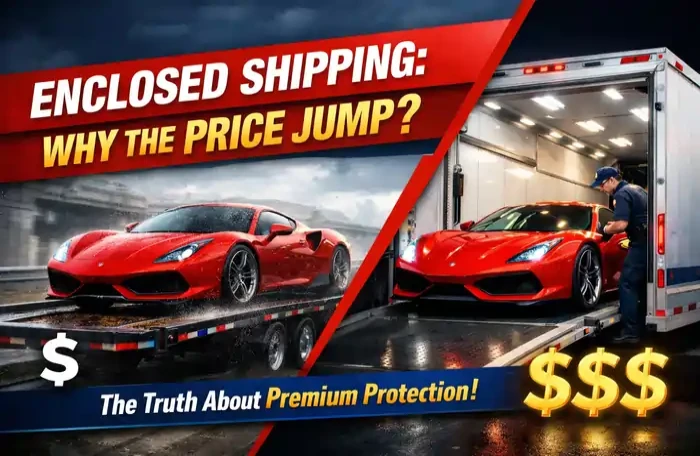


Enclosed car shipping usually costs more than open transport because of different factors, including lower capacity, higher equipment costs, and greater financial exposure per vehicle.

Fewer Cars Per Trailer Means Higher Cost Per Car
Open carriers are built for volume. Most haul seven to ten vehicles at once. That density spreads fuel, tolls, driver wages, and insurance across more paying customers.
Enclosed trailers do not have that flexibility. The solid walls and roof limit how vehicles can be stacked. Many enclosed units carry one to six cars. When one slot produces less total revenue per mile, each vehicle inside must carry more of the operating cost.

The difference shows up in rates. Open transport commonly falls between $0.60 and $1.20 per mile per car. Enclosed shipping often ranges from $1.30 to $2.10 per mile. On a 1,500-mile move, that gap can mean several hundred dollars.
Now consider vehicle size. A full-size luxury SUV or large electric truck can consume the space of two smaller sedans inside an enclosed trailer. When usable capacity drops, the rate per vehicle rises.
The Equipment Is Significantly More Expensive
A commercial open car hauler trailer can range from $43,000 to $158,000. A comparable enclosed commercial trailer often runs from $197,000 to more than $250,000.
That purchase price is not cosmetic. Enclosed units rely on hydraulic liftgates that keep low-clearance vehicles level during loading. Many also use air-ride suspension systems to reduce vibration. Those systems protect high-value vehicles from scraping and road shock. They also cost money to buy, maintain, and repair.
Maintenance costs follow the same pattern. Annual upkeep for a professional enclosed fleet can reach $4,000 to $7,000 or more, compared to $1,200 to $4,000 for open fleets. Tires, lift systems, seals, and interior components all add recurring expense.
When you see a higher enclosed quote, part of what you are paying for is the recovery of that capital investment.
Insurance and High-Value Risk
All interstate carriers must carry liability coverage. In practice, most operate with $1 million in liability limits. The difference appears in cargo coverage.
An open trailer might carry $100,000 to $250,000 in cargo coverage for the entire load. An enclosed carrier transporting exotic or collector vehicles may carry $500,000 to $1,000,000 or more.
Insurance premiums reflect the worst-case scenario, not the average day. When one vehicle inside a trailer is worth more than many standard sedans combined, the financial exposure changes. Annual insurance costs for enclosed owner-operators are typically higher than for open operators.
If you are shipping a vehicle valued at $150,000 or $500,000, the insurance structure matters. The enclosed premium often looks smaller when compared to the potential repair or depreciation loss.
Fuel and Operating Inefficiency
An enclosed trailer is a large, solid box moving through the air. It creates more aerodynamic drag and weighs more than an open-frame trailer. Testing shows that towing enclosed units can reduce fuel economy by roughly 30 percent compared to open trailers.
Lower fuel efficiency increases per-mile operating cost. Over thousands of miles, the difference is meaningful. Add heavier components and more complex systems, and long-term wear rises as well.
These are not abstract line items. They show up in every quote.
Environmental Exposure and Asset Protection
Open transport works well for most daily drivers. It is safe, widely used, and handles the majority of domestic shipments.
Enclosed shipping eliminates exposure to rain, snow, road salt, debris, and UV radiation. For many owners, that matters less than they think. For others, it is everything.
Bird droppings and salt can etch a clear coat if left on the surface for days. A small chip on a standard sedan might be cosmetic. On a classic vehicle with original paint, it can affect resale value.
Modern electric vehicles introduce another layer. Demand for enclosed transport has increased in recent years, in part because of sensitivity around battery systems and advanced exterior sensors. While standard open and enclosed transport are both available for EVs, owners of high-value models often prefer a controlled environment.
Scheduling and Route Density
Open carriers dominate the market, handling roughly 90 percent of domestic vehicle moves. Enclosed carriers represent a smaller share.

Fewer enclosed units on the road means fewer route combinations at any given time. That can translate into narrower scheduling windows and less flexibility when matching multiple high-value vehicles on one trailer.
If you are shipping between major metro areas, availability tends to be stronger. If your pickup or delivery location is remote, coordination may take longer.
Is the Premium Worth It?
For a standard commuter vehicle, open transport usually makes financial sense. The cost savings can be significant, especially on longer routes where per-mile rates drop for both methods.
For a rare collector car, a newly restored classic, or a high-value luxury or electric model, the calculation shifts. The enclosed premium often represents a small percentage of the vehicle’s value.
When customers work with AmeriFreight Auto Transport, they see this tradeoff clearly. No upfront payment until you choose a carrier. Agents walk through open and enclosed options, explain what affects rates, and help match the transport method to the vehicle’s value and the owner’s comfort level.
Disclaimer
Rate ranges are industry averages and can vary based on distance, vehicle size, route demand, and carrier availability. AmeriFreight Auto Transport provides customized quotes, not exact prices, and does not offer insurance. Optional AFTA gap protection plans are available. No upfront payment until you choose a carrier.