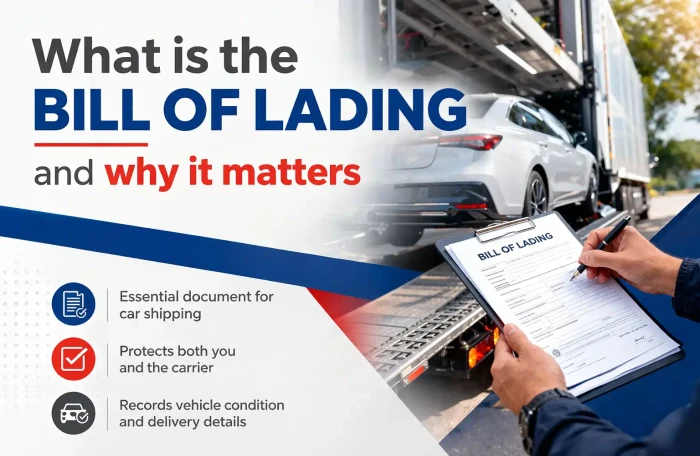


In auto transport, the Bill of Lading, often shortened to BOL, is the document that acts as your contract, your pickup receipt, and your official vehicle condition report. It determines what happens if damage is found later, who had possession of the car at a specific time, and what you agreed to, even if you did not read it carefully.
Under federal transportation law, a bill of lading functions as a legally binding contract between the shipper and the carrier. The U.S. Department of Transportation recognizes it as the official document that establishes transport terms and liability responsibilities.
That legal weight changes how you should treat the form. Many vehicle owners assume damage disputes depend on photos alone. In practice, claims depend heavily on what is written on the BOL.
It Is the Legal Agreement for Transport

The auto transport bill of lading outlines the terms under which the vehicle moves from the pickup location to the delivery location. It identifies the carrier, confirms the shipment route, and lists the responsibilities tied to the move.
Federal regulations require carriers transporting vehicles across state lines to carry liability coverage. The FMCSA requires a minimum of $750,000 in liability insurance for most interstate carriers transporting property.
That insurance protects against carrier negligence, but the bill of lading defines the condition the vehicle was in before transport. Without that written baseline, insurance claims become harder to resolve.
Because insurance pays based on a documented change in condition. The BOL is the baseline record.
It Is Also Your Pickup Receipt
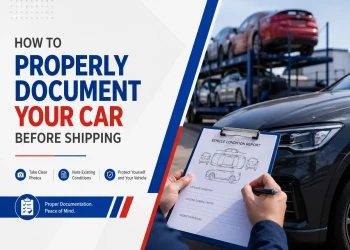
At pickup, the driver inspects the vehicle and notes visible damage directly on the vehicle bill of lading. Scratches, dents, cracked glass, chipped paint. The more precise the notes, the clearer the starting point.
When you sign at pickup, you confirm two things:
The carrier has taken possession of the vehicle.
The condition notes reflect what you see.
That signature transfers custody. If the vehicle is shipped using Door-to-Door Service (Location Permitting), the inspection still happens at the actual pickup location, even if that location is nearby rather than directly in front of your home.
Many customers quietly assume minor scratches do not need documentation. Later, if that same panel has additional damage, the absence of a written record complicates claims.
The BOL Is the Official Condition Report
The vehicle inspection portion of the auto transport bill of lading is often the most important section.
The driver marks damage on a diagram or digital checklist. Both parties sign at pickup. At delivery, the vehicle is inspected again. Any new damage must be written on the delivery portion before the final signature.
This is where disputes either get resolved quickly or turn difficult. The FMCSA emphasizes that consumers should carefully inspect shipments at delivery before signing paperwork.
While this page focuses on household goods, the same inspection principle applies in auto transport. Once the delivery section is signed without damage noted, proving later damage becomes significantly harder.
If it was not documented at delivery, you are already in a weaker position. Documentation timing matters.
What Must Be Included on a Vehicle Bill of Lading
A complete BOL auto transport form typically includes:
Full legal names and addresses of the shipper and receiver
Vehicle year, make, model, and VIN
Pickup and delivery addresses
Special handling instructions
Agreed charges
Signature lines for pickup and delivery
An incorrect VIN can delay claim processing. Missing damage notes can invalidate a dispute. Incomplete contact information can slow resolution. Precision reduces friction later.
The Bill of Lading Is Not Insurance
This is one of the most misunderstood parts of car shipping. The bill of lading documents the condition and responsibility. It does not provide full coverage by itself.
Carrier liability coverage applies according to federal minimum requirements. However, liability coverage does not automatically equal full vehicle value reimbursement. Claims are evaluated based on negligence and documented damage.
AmeriFreight Auto Transport does not offer insurance policies. Optional AFTA plans are available as gap protection plans, not insurance. If you select an AFTA plan, you have 48 hours after delivery to report damage. That reporting window is strict. Waiting beyond that timeframe can affect eligibility. Delays reduce leverage.
Electronic Bills of Lading Are Legally Valid
Many carriers now use electronic BOL systems. These digital documents hold the same legal validity as paper versions under federal electronic signature laws.
The Electronic Signatures in Global and National Commerce Act confirms that electronic signatures carry the same legal effect as handwritten signatures. Electronic forms often reduce illegible handwriting issues and preserve digital timestamp records. That timestamp can become important if there is disagreement about when the delivery occurred.
However, electronic does not mean more protection. The same inspection diligence applies. Real-time GPS tracking is not offered, and the BOL itself does not function as a live tracking tool.
The Bill of Lading Is Separate From Your Invoice
Customers often confuse the invoice with the bill of lading. The invoice reflects charges owed. The BOL reflects conditions and contractual transport terms.
You may receive a quote before dispatch. AmeriFreight Auto Transport operates with no upfront payment until you choose a carrier. The bill of lading is completed when the vehicle is physically picked up by the carrier.
Signing an invoice confirms payment terms. Signing a BOL confirms condition and custody. Those are different legal acknowledgments.
Personal Items and DOT Rules
Another common misunderstanding concerns items inside the vehicle.
The U.S. Department of Transportation does not permit personal household goods to be transported inside vehicles under standard vehicle transport authority. Some carriers may allow limited personal items under specific weight limits for an additional fee, but that must be arranged beforehand. Unauthorized items can increase risk and create complications if damage occurs.
Where People Misjudge the Risk
Three quiet assumptions tend to create problems:
“The carrier’s insurance will handle everything.”
Claims rely on documentation. The BOL defines that documentation.“Small scratches are not worth mentioning.”
Minor damage becomes major when new damage overlaps old damage.“Paperwork is standard, so I can sign quickly.”
Your signature legally affirms accuracy.
If damage occurs and the BOL is complete and accurate, disputes are usually straightforward. If documentation is incomplete, resolution becomes slower and less predictable.
The BOL is the single document that determines how protected you are if something goes wrong during transport.
Disclaimer:
This content is provided for informational purposes only and does not constitute legal advice. Federal regulations, carrier requirements, and insurance terms may change. Always review your specific Bill of Lading and carrier agreement carefully and consult with the carrier or a qualified legal professional if you have questions about your rights, responsibilities, or coverage.