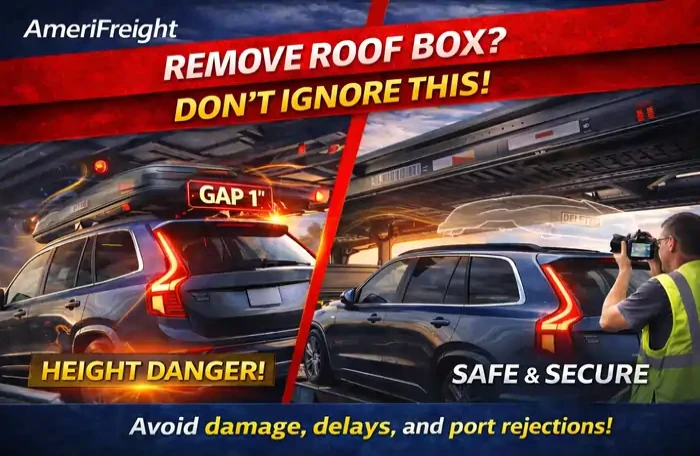


In most situations, removing the roof box is the safer decision.
Not because roof boxes are poorly made; many are excellent. It comes down to exposure, inspection, and liability once your vehicle is in someone else’s custody.
With AmeriFreight Auto Transport, vehicles move on open or enclosed carriers. Either way, a roof-mounted cargo box changes the equation.
What Carriers and Ports Actually Require
If your shipment involves a port or ocean leg, removal is often not optional. Matson’s vehicle preparation guidance states that roof cargo carriers must be removed before shipment.
Pasha Hawaii’s preparation guide distinguishes between permanently installed equipment and removable exterior accessories. Removable racks and similar items are not accepted.
That alone settles the issue for port shipments. A roof box can cause a same-day rejection at drop-off.
For domestic land transport, policies vary more. Some enclosed carriers state they can ship vehicles with roof racks, but overall height must be disclosed and may affect pricing.
AmeriFreight’s own guidance makes a similar point: if a modification changes the vehicle’s stock dimensions, it must be disclosed in advance. That disclosure matters. A multi-car trailer has tight clearance margins. An added 10 to 20 inches of height can determine where your vehicle fits, or whether it fits at all.
Height, Wind, and Forces You Do Not See
You might be thinking, “It’s securely mounted. I drove across three states with it.”
Driving your own car is different from placing it on a commercial carrier for several days.
Thule’s roof box instructions warn that vehicle height can increase by up to 700 mm, depending on rack configuration. They also stress periodic checks to ensure the box is firmly secured and locked.
Yakima’s SkyBox instructions similarly advise checking attachment hardware before starting a journey and at intervals, and note handling changes at highway speeds.
Once your vehicle is on a transporter, no one is stopping every 100 miles to re-check clamp tension.
Federal Motor Carrier Safety Administration cargo securement performance standards require securement systems to withstand forces equivalent to 0.8 g forward deceleration and 0.5 g lateral acceleration.
Those standards apply to commercial cargo securement, not your roof box specifically. Still, they reflect the real forces present in trucking environments: braking, lane changes, and crosswinds. A roof box experiences sustained wind and vibration for hundreds or thousands of miles, without inspection. That is the part most people overlook.
Open vs Enclosed Transport Changes the Risk

Open transport is widely described as the most common and cost-effective option, but it exposes the vehicle to weather and roadway debris. Enclosed transport shields vehicles from external elements and is often chosen for higher-value vehicles.
On an open carrier, a roof box faces road grit, sun, rain, and debris. On an enclosed carrier, exposure risk drops, but height becomes a harder constraint. If the vehicle plus roof box exceeds trailer clearance, the shipment can be delayed or reconfigured.
If you are shipping a performance car, luxury vehicle, or vehicle with tight height tolerances, that added dimension is not trivial.
Documentation and Claims Reality
Most roof damage disputes do not hinge on catastrophic failure. They hinge on documentation.
A BBB complaint involving roof damage after shipment illustrates how disputes often center on intake photos and inspection reports.
A roof box can obstruct full inspection of the roof surface. If the bill of lading notes “unable to inspect” areas, you may have created an avoidable claims problem. Many carriers also clarify that personal items are not covered under transport insurance and often limit the weight inside the vehicle.
The DOT does not permit personal household goods to be transported in vehicles. If a carrier allows limited items, it must be discussed beforehand and is often subject to restrictions. A roof box full of belongings complicates that issue immediately.
Manufacturer Guidance Is Subtle but Clear
Vehicle manufacturers publish maximum roof load limits that include rack and accessory weight. Tesla documentation lists specific maximum roof rack load limits, such as 75 kg or 100 kg, depending on configuration.
Volvo’s XC90 support materials show a maximum roof load of 100 kg. Those limits are written for driving, not transport. Still, they underscore that roof systems operate within defined tolerances.
Roof box manufacturers go further. Thule explicitly advises removing roof racks and accessories when not in use. Shipping is a scenario where the roof box is not being used for its intended purpose. It is simply adding exposure.
When Leaving It On Might Make Sense
There are limited cases where leaving a roof rack or box installed is workable.
If you are using an enclosed carrier that confirms in writing it accepts roof-mounted accessories, and you disclose the total vehicle height in advance, it may be permitted.
Even then, best practice would be:
Empty the box completely.
Lock it.
Photograph all mounting points and roof corners.
Ensure the bill of lading reflects the visible condition accurately.
Assume the roof box itself may be treated as an accessory, not as part of the vehicle’s insured body.
If the box is a soft roof bag secured with door-clip straps, removal is strongly advisable. Manufacturer materials emphasize correct installation and warn that improper attachment can lead to damage or shifting. Soft systems rely heavily on tension and friction. Those are not conditions you want left unmonitored during multi-day transport.
The Practical Answers Most Owners Need
If you are asking, “Is this just an extra precaution?”, the answer is no. It is a risk management decision.
If you are thinking, “The carrier is insured,” remember that liability frameworks such as the Carmack Amendment govern interstate cargo claims in specific contexts, but recovery still depends heavily on documentation and contract terms.
If you are assuming, “They will just work around it,” understand that undisclosed height changes can lead to re-pricing or dispatch delays.
If you are hoping, “It will save space inside the car,” know that personal items are generally discouraged and may not be covered.
Removing the roof box simplifies:
Clearance planning.
Condition inspection.
Claims documentation.
Wind and vibration exposure.
It removes an accessory that manufacturers themselves recommend taking off when not in use.
For most shipments, especially open transport or port moves, removal is the safer, cleaner decision. If you choose to leave it installed, do so only after written confirmation that it is accepted, and treat it as a special condition requiring careful documentation.
In vehicle transport, fewer variables usually mean fewer surprises.
Disclaimer:
The information in this article is provided for general educational purposes only and does not constitute legal, insurance, or transportation policy advice. Carrier requirements, port regulations, manufacturer guidelines, and insurance terms may change and can vary by shipment, vehicle type, and route. Always confirm specific preparation requirements in writing with your carrier, broker, port authority, and insurance provider before transport. AmeriFreight Auto Transport policies and third-party carrier rules may differ by situation.