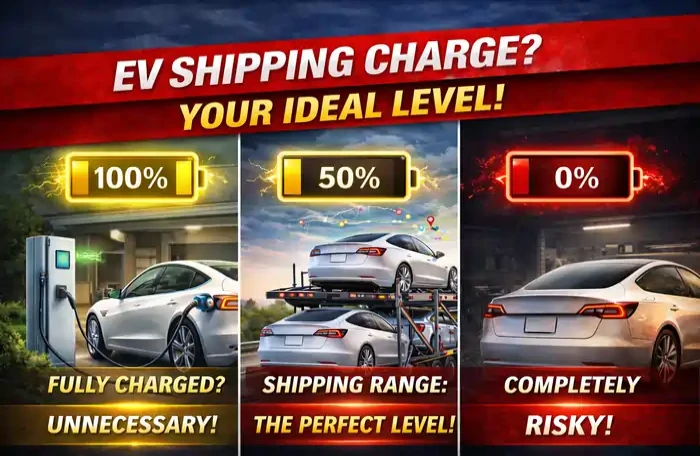


For ground car shipping, a practical target is about 40 percent state of charge, with 30 percent to 50 percent as a reliable working range. It is enough to keep the car functional if it wakes up occasionally, and it avoids the higher-energy behavior that comes with a nearly full pack.
Most people are quietly assuming two things they never say out loud: that the vehicle will not draw power while parked, and that if it does, charging access will be simple. Standard auto transport is not built around dependable charging access, which is why starting with a buffer matters more than “maxing out.”
Why A High Charge Is The Wrong Default For Shipping
A lithium-ion battery at a high State of Charge stores more chemical energy. In normal driving, that is just more usable miles. In a rare battery failure scenario, it can change severity.
In controlled thermal runaway testing summarized in the EV transport research, the maximum temperatures and gas release both climbed sharply as the State of Charge increased. At 100 percent SoC, the maximum temperature reached 1,082.1°C, compared with 357.4°C at 50 percent SoC.
The same data set recorded gas production rising from 0.90 mol at 50 percent to 2.33 mol at 100 percent. Those numbers are hard to ignore, and they are the clearest explanation for why “topping off” before transport is a poor trade.
According to the NFPA, EV battery incidents can involve hazards that do not behave like a typical fuel fire, and energy can remain within the system even after shutdown. That concept, often described as residual or “stranded” energy in safety discussions, is exactly why reducing stored energy before shipping is a reasonable precaution.
Why Shipping Too Low Creates Real-World Problems
Shipping near empty sounds cautious until you think about how EVs behave when parked.
Even when an EV is “off,” it may wake up for connectivity, security, or thermal management. The drain rate depends on model and settings, but the decision risk is consistent: the lower the starting charge, the less room you have for normal background use before the vehicle becomes difficult to move.
The EV transport research notes that EVs can lose charge while idle and that drain can accelerate when certain features remain active. You do not need a precise daily percentage to see the consequence. A vehicle that starts at 15 percent is fragile. A vehicle that starts around 40 percent has a buffer that makes the shipment more resilient to ordinary staging time and minor delays.
This is the unstated question most owners are holding: “What is the lowest I can go without risking an arrival problem?” For most ground moves, keeping the vehicle above roughly 30 percent helps avoid end-of-transport surprises.
The 30 Percent To 50 Percent Window Works For One Simple Reason
The 30 percent to 50 percent range exists because it balances the only two outcomes that actually change your shipping experience:
Too high, and you carry unnecessary stored energy, with test data showing far more severe heat and gas behavior at high SoC.
Too low, and you increase the odds that the vehicle arrives in a low-power condition that complicates unloading and handoff.
If you want one number you can remember and hit without fuss, aim for about 40 percent. It sits comfortably inside the window and does not require perfection.
If you want a manufacturer-style “sanity check” for what “moderate” looks like in practice, Ford’s battery care guidance emphasizes avoiding extremes as a general habit, which aligns with the broader idea that moderate charge is steadier than sitting very high for extended periods.
Drain Control Is The Part People Skip
Battery level is only half the preparation. The other half prevents the vehicle from wasting that charge while it sits.

Many EVs have a transport-focused mode that keeps the vehicle controllable and reduces unnecessary wake-ups. According to Tesla’s Instructions for Transporters, Transport Mode supports safe handling during loading and unloading, including movement-related considerations that matter when a vehicle is being positioned on a carrier.
Owners often assume transport mode is only for breakdowns. In shipping, it is often the difference between arriving with a healthy buffer and arriving close to the threshold where the car starts acting unpredictably, even though nothing “went wrong” in the dramatic sense.
Weight And Handling Add Context To The Battery Decision
EVs are heavier than comparable gasoline vehicles, and that changes how carriers plan loads and secure vehicles. In the EV transport research, the Ford F-150 Lightning was listed at 6,015 pounds, compared with 4,060 pounds for a gasoline F-150, a 48.2 percent increase.
That extra mass does not change the battery target, but it raises the value of predictability. If a vehicle arrives low and needs extra handling, you are adding complexity in an environment that already has tighter physical constraints.
How The Battery Guidance Shows Up In Everyday Shipping Decisions
In day-to-day customer conversations, the battery question usually surfaces alongside practical service choices: open versus enclosed, driveway pickup versus meeting at a nearby safe spot, and how much access a large carrier will realistically have in a dense neighborhood. That is the context where a “moderate charge” recommendation earns its keep. It reduces the chance your EV becomes the one that needs special attention at the end of the route.
This is also where AmeriFreight Auto Transport typically frames the discussion around standard EV shipping methods, using either open auto transport or enclosed auto transport, while treating Door-to-Door Service as location-dependent in the real world, not a promise that a truck can reach every driveway.
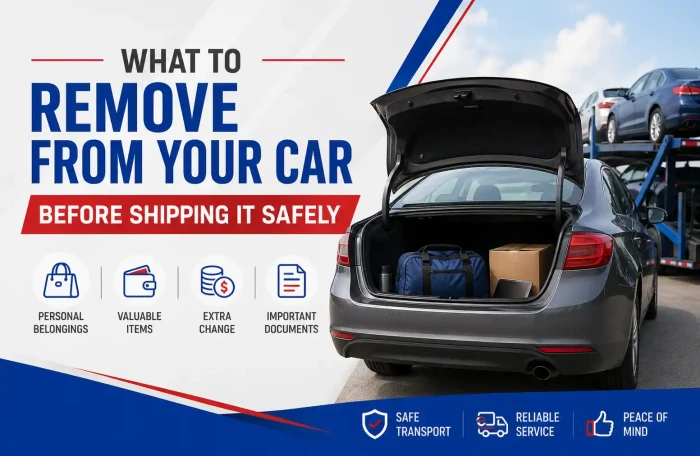
One more point that affects effort and risk is what can be inside the vehicle. The U.S. DOT does not permit personal items to be shipped in vehicles, and if a carrier allows limited items, it is usually for an added fee and must be discussed beforehand.
The Battery Level That Holds Up In Real Shipping Timelines
For ground car shipping, avoid the extremes. Do not ship the vehicle nearly full, and do not ship it nearly empty.
Aiming for about 40 percent and staying within 30 percent to 50 percent is a practical approach that reduces stored-energy severity at the high end and reduces “arrives too low to behave normally” risk at the low end. When you pair that with transport mode or drain-reducing settings where your vehicle supports them, the plan aligns with how shipping actually works, not how it looks in a perfect one-day scenario.
Disclaimer
This article is for general informational purposes only. It does not replace manufacturer guidance, carrier instructions, or federal transportation regulations. Battery recommendations may vary by vehicle model, carrier policy, and weather conditions. Always confirm preparation requirements with your vehicle manufacturer and your assigned carrier before shipping.