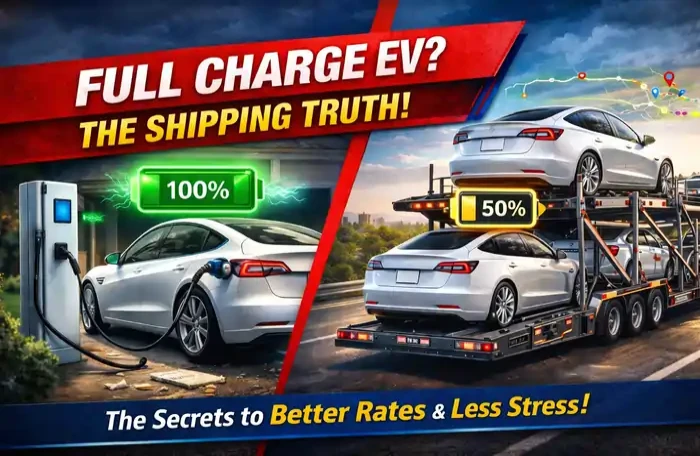


You don’t need to fully charge your EV before shipping. In fact, a topped-off battery doesn’t solve any real transport problems and can actually add exposure. What you need is enough charge for the vehicle to operate normally at pickup and delivery, not a full battery sitting at maximum capacity for days.
For most shipments arranged through AmeriFreight Auto Transport, a mid-range state of charge is the practical and safer choice. In real-world EV transport guidance, that typically means keeping the battery between 30 percent and 50 percent rather than 100 percent.
Most owners ask this because they are thinking about the range. People tend to overcorrect here. The assumption is that more range equals more safety. In shipping, a wider range often just means more stored energy than necessary.

Why 100 Percent Is Rarely Ideal for Transport
Lithium-ion batteries behave differently from fuel tanks. A higher state of charge means more stored energy and higher voltage stress inside the battery pack. That matters during transport, where vehicles may sit idle, experience temperature swings, or be moved multiple times.
According to the Pipeline and Hazardous Materials Safety Administration (PHMSA), lithium battery transport safety centers on risk mitigation and careful energy management, which is one reason industry practices avoid unnecessarily high charge levels during handling.
Lithium-ion battery incidents can be complex and severe, reinforcing why minimizing avoidable stored energy is a reasonable precaution in transport contexts. A full battery does not make loading easier, but it does increase total energy on board.
The More Balanced Target
A common and practical target is roughly 30 to 50 percent state of charge. That level provides enough energy for normal loading and unloading while reducing the time the battery sits at a high state of charge. It also creates room for natural drainage without pushing the vehicle into a low-power situation.
This is where many owners quietly worry: “What if it arrives nearly empty?” An EV that drops too low can enter reduced-power modes or behave unpredictably, which complicates delivery. Starting in the middle of the range is what keeps that from happening.
Idle drain is real, and it adds up
EVs lose charge while parked. The exact amount varies by model and settings, but manufacturers acknowledge that extended idle time and charging habits influence battery health and readiness. Ford’s battery maintenance guidance highlights how storage and state of charge affect long-term condition and performance.
Shipping should be treated like a short storage window. If the vehicle sits for several days, background systems such as security features or connectivity can reduce the battery level further. Starting at a moderate charge gives you margin without keeping the pack at maximum for the entire trip.
Temperature Changes the Calculation
Battery percentage does not exist in a vacuum. In colder conditions, EVs may use additional energy to warm or protect the battery, which can slightly increase drain during idle time. In high heat, the combination of elevated temperature and high state of charge is less desirable from a battery stress perspective.
Allianz Commercial’s risk discussion around lithium-ion batteries emphasizes how stored energy and environmental conditions influence incident severity. If you are shipping in winter, leaning toward the higher end of your mid-range target can provide a useful buffer. In very hot conditions, avoiding a near-full charge is generally more conservative.
Settings matter as much as charge level
Charge percentage is only part of the preparation. Reducing unnecessary battery drain during transport is equally important. If your vehicle offers a transport or tow mode, use it according to the manufacturer’s instructions.
Tesla’s transporter guidance outlines proper handling procedures so the vehicle can be moved safely and predictably during shipping. Disabling high-draw features you do not need, especially those that keep the vehicle actively monitoring its surroundings, helps preserve the buffer you planned for. Shipping is not the time to leave every convenience feature running.
Practical Realities Most Owners Don’t Say Out Loud
Many people assume the carrier will charge the vehicle if it runs low. It is safer to plan as if charging will not occur during transit. The job is transporting an operable vehicle, not managing its energy strategy along the way.
Another assumption is that the battery chemistry changes the answer. Even if your EV’s manual allows higher daily charging in normal use, transport is a different context. It involves extended idle time, environmental exposure, and standardized handling practices that favor moderation.
What This Means in Real Terms
You do not need to fully charge your EV before car shipping. In most cases, that approach introduces more stored energy than necessary and offers no practical advantage. A moderate state of charge provides the flexibility you need for loading, unloading, and short-term drain without placing the battery at a prolonged high level.
For most situations, aiming for roughly the middle of the battery gauge is the balanced choice. It reflects how lithium battery transport risk is framed by regulators such as PHMSA and how commercial risk analysts view stored energy exposure in lithium-ion systems.
Disclaimer
This article is for general informational purposes only. It does not replace manufacturer guidance, carrier instructions, or federal transportation regulations. Battery recommendations may vary by vehicle model, carrier policy, and weather conditions. Always confirm preparation requirements with your vehicle manufacturer and your assigned carrier before shipping.