

Shipping a car can be confusing, especially if it’s your first time. This glossary explains the common words used by car shippers and transport companies in plain language. With this guide, you’ll understand the process, know what to ask, and feel confident when shipping your vehicle. It’s a quick and easy way to learn how car transport really works.

A. Core Auto Transport Terms
Auto Logistics
The planning, scheduling, and management of vehicle transportation. Includes route optimization, inventory tracking, and delivery coordination.
Auto Shipping / Car Shipping
A general term for moving a car, SUV, or truck across short or long distances. Includes state-to-state shipping, cross-country transport, and international export.
Auto Train / Autorack / Rail Service
A train service designed to move vehicles in bulk using specialized railcars (autoracks).
Auto Transport
The process of shipping a car or other vehicle from one location to another using specialized carriers or trailers.
Auto Transport Company
A licensed and insured business that coordinates or conducts vehicle shipping, either directly as a carrier or indirectly as a broker.
Car Hauler / Auto Hauler / Carrier
The truck or trailer used to move vehicles. Car haulers may be open carriers (standard, affordable) or enclosed carriers (premium protection).
B. Licensing, Compliance & Regulations
Bonded and Insured
Bonded: The company holds a surety bond protecting customers and carriers.
Insured: The company’s insurance covers vehicle damage during transport.
Bonded: The company holds a surety bond protecting customers and carriers.
Insured: The company’s insurance covers vehicle damage during transport.
COI (Certificate of Insurance)
Proof that the transporter’s insurance policy is valid. Always request a COI before booking.
MC Number
Issued by the Federal Motor Carrier Safety Administration (FMCSA), granting permission to operate as a motor carrier or broker in interstate commerce.
TWIC (Transportation Worker Identification Credential)
A federal security clearance card required for entry into shipping terminals and ports.
USDOT Number
A unique ID assigned by the Department of Transportation (DOT) to carriers and brokers operating commercial vehicles across states.
C. Documents & Paperwork
Bill of Lading (BOL)
The primary shipping contract and receipt between the carrier and the customer. Documents vehicle condition at pickup and delivery.
Proof of Delivery (POD)
A signed document verifying successful delivery in good condition.
Quote or Estimate
A cost prediction for shipping services that may vary based on distance, route, and vehicle type.
Rate Confirmation
An agreement between shipper and carrier detailing pickup/delivery points and payment terms.
Reservation Fee / Deposit
An upfront payment to reserve transport space, usually applied toward the final balance.
Vehicle Inspection Report (VIR)
Records the condition of a vehicle before and after transport; used for damage verification.
D. Shipping Methods & Services
Door-to-Door Transport
Pickup and delivery directly to customer addresses when legally and physically accessible.
Driveaway Service
A professional driver personally drives your car to its destination.
Enclosed Carrier Transport
Premium service offering protection from weather and debris.
Expedited Auto Transport
Prioritizes faster pickup and delivery using dedicated carriers.
Flatbed Transport
Used for oversized or non-standard vehicles such as machinery or RVs.
Nationwide / Cross-Country Shipping
Refers to shipping coverage across the entire U.S., including coast-to-coast routes.
Open Carrier Transport
The most common and less expensive method; vehicles are exposed to the elements but securely tied down.
Terminal-to-Terminal Transport
A lower-cost method where vehicles are dropped off and picked up from storage terminals.
E. Vehicle Conditions & Equipment
Inoperable (INOP) Vehicle
A vehicle that cannot drive on or off a carrier under its own power.
Operable Vehicle
A vehicle that can drive on or off the carrier using its own power.
Oversized Vehicle
A vehicle exceeding standard size or weight limits, often requiring special equipment or permits.
Tie-Downs / Wheel Straps / Chains
Equipment used to secure vehicles during transport.
Top Load / Bottom Load
Vehicle placement options on multi-level carriers; top load offers more protection from debris.
Winch
A powered cable device used to load inoperable vehicles onto carriers.
F. Payment Terms & Pricing
Cash on Delivery (COD)
Payment made directly to the driver at the time of delivery.
Cash on Pickup (COP)
Payment made before transport begins.
Fuel Surcharge (FSC)
Additional fee based on fuel price fluctuations.
Quote Calculator
An online tool to estimate vehicle shipping cost by distance, route, and carrier type.
G. Industry Roles
Broker
A licensed intermediary who connects shippers with carriers.
Carrier / Driver
The company or individual responsible for physically transporting vehicles.
Consignee / Receiver
The person or entity receiving the shipped vehicle.
Dispatcher
Coordinates routes, driver schedules, and customer communication.
Fleet Management
The oversight of multiple vehicles, ensuring maintenance, efficiency, and route optimization.
Shipper / Consignor
The customer or company arranging the shipment of a vehicle.
H. Technology & Software
CRM (Customer Relationship Management)
A software system used to manage client communications and service records.
Electronic Logging Device (ELD)
Tracks driver hours and ensures compliance with FMCSA regulations.
Telematics / GPS Tracking
Provides real-time location and performance data for shipments.
Transport Management System (TMS)
Software that automates booking, tracking, and documentation.
I. Delivery, Timing & Routing
Backhaul / Deadhead
A return trip with or without cargo that affects transport pricing efficiency.
Guaranteed Pickup Date
Premium service guaranteeing pickup on a specific date.
Pickup & Drop-Off Window
Estimated timeframe for vehicle collection and delivery.
Route
The planned path between pickup and destination.
Transit Time / Estimated Time of Arrival (ETA)
The total duration from vehicle pickup to delivery.
J. Vehicle Types & Special Shipments
Boats
Use special trailers or cradles for safe transport.
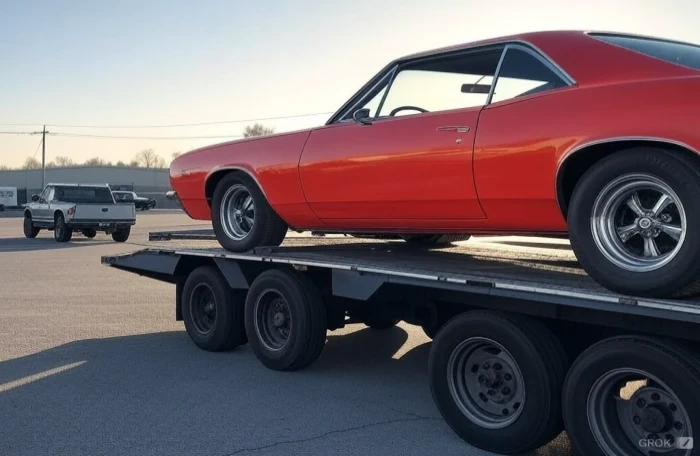
Classic Cars / Vintage Cars / Muscle Cars / Sports Cars
High-value vehicles that benefit from enclosed transport.
Electric Vehicles (EVs)
Need extra care for battery safety during transport.
Golf Carts / ATVs / UTVs
Small vehicles that ship securely with straps or in covered trailers.
Motorcycles
Transported via enclosed or open motorcycle-specific carriers.
POV (Privately Owned Vehicle)
Personal or government vehicles shipped for relocation.
RO-RO (Roll-On, Roll-Off)
A method for overseas shipping where vehicles are driven onto the vessel deck.
RVs
Large vehicles often moved by flatbed or driveaway service.
K. Insurance, Risk & Safety
Cargo Insurance
Protects items being transported on the carrier.
Force Majeure
Natural disasters or events beyond control that may exempt carriers from liability.
Insurance Coverage
The general policy covering loss or damage during vehicle transport.
Inspection Report
A written record of the vehicle’s condition before and after shipment.
Liability Insurance
Protects carriers if they are found responsible for damage.
L. Additional Concepts
Customer Reviews / BBB Ratings
Public feedback and accreditation used to verify company reputation.
Gated Community Access
Restrictions that may prevent large carriers from entering neighborhoods.
Reservation Fee / Deposit Policy
Payment required to secure a transport booking.
Snowbird
Seasonal traveler shipping a vehicle between northern and southern states.
Speed Bumps / Narrow Streets
Common delivery obstacles requiring alternate drop-off arrangements.
M. International Shipping & Customs
Export / Import
The movement of vehicles across international borders, requiring customs documentation.
Freight Forwarder
A third-party logistics provider that manages international vehicle shipments.
Tariffs / Taxes / Duties
Government-imposed fees for importing or exporting vehicles.
Ready to Ship with Confidence?
Understanding auto transport terms is only the beginning. At AmeriFreight Auto Transport, we make car shipping easy by coordinating with a network of licensed, insured carriers and guiding you every step of the way.
Get your free instant quote now.