
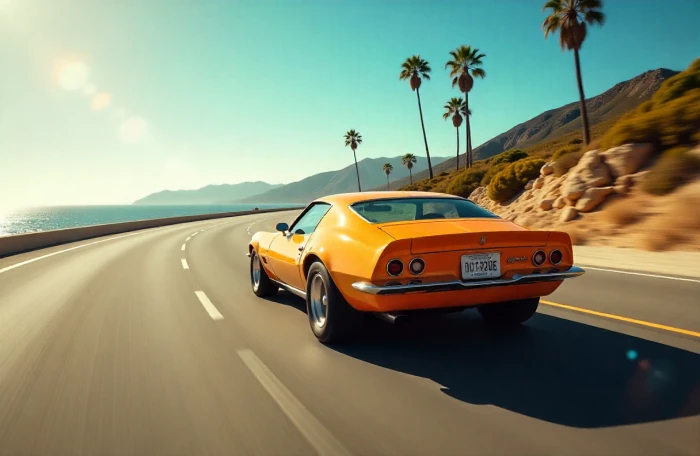


The Speed Racer Mach 5 has lasted for decades for one reason. It never felt like a throwaway cartoon prop. From its first appearance in the 1967 anime Speed Racer, originally released in Japan as Mach GoGoGo, the car looked like it belonged in the same conversation as real performance machines of its era.
That grounding gave it unusual staying power, and it still shapes how fans, collectors, and builders think about fictional cars today. The series itself became one of the early Japanese anime exports to the United States, helping turn the Mach 5 into a recognizable part of American pop culture, not just anime history.

That reach matters. The Mach 5 was not only memorable because it was fast or visually striking. It treated engineering as part of the story. Viewers were not just watching races. They were watching a machine respond to problems in real time, and that detail stayed with people.
The Design Borrowed From Real Performance Cars
The Mach 5’s shape was stylized, but it stayed close to real automotive design trends. Its form reflects 1960s European performance cars, especially models from Ferrari, Porsche, and Jaguar. The long nose, low stance, and narrowed midsection align with the “coke-bottle” styling that defined that era.
The design is credited to Mitsuki Nakamura of Tatsunoko Production, placing the car firmly within the studio’s creative and technical direction. Several visual elements still define it:
white body with blue accents
red “M” on the hood
two-seat layout
left-hand drive configuration
racing number 5
The “M” ties back to Mifune Motors, the Racer family business in the original Japanese version of the series, which adds context. The car is not just Speed’s vehicle; it represents a family-built machine tied to independence and craftsmanship.
The Mechanical Lore Feels Surprisingly Detailed
The Mach 5 is often described as a front-engine, two-seat racing car powered by a fictional GOV12 V12 engine. Some technical summaries place its performance at around 16,000 RPM, with an estimated top speed of about 350 km/h, or roughly 217 mph.
Estimated Performance Profile
These figures belong to the lore of the series rather than real engineering specifications. Still, they help explain why the car felt plausible enough to inspire real builds. The technical framing gave it weight. It was not treated as a vague concept. It was presented as a machine with defined limits and capabilities.
The A Through G Controls Defined The Car
The Mach 5’s steering wheel controls set it apart from every other fictional car of its time. Each labeled button activated a system designed to handle specific challenges.
Several of these ideas now have real-world parallels. The Evening Eye resembles modern infrared and night-vision systems. The Deflector mirrors the concept behind reinforced driver safety structures. Belt Tires reflect the same goal as modern traction and terrain management systems.
The Auto-Jacks remain the most extreme concept. One fan calculation estimated that launching a car of roughly 1,000 kilograms several meters into the air would require energy equivalent to about 877 horsepower, along with forces near 30,000 newtons. While not official data, it gives a sense of scale and shows how far the design pushed beyond conventional engineering.
The 2008 Film Kept The Core Design Intact
The 2008 Speed Racer film expanded the world around the Mach 5 but left the car itself largely unchanged. That decision reinforced how central the design had become to the identity of the franchise.
The film introduced more detailed fictional systems, including T-180 race cars and upgraded gadget concepts, but the Mach 5 remained the emotional center of the story. It still carried the same shape, proportions, and visual cues that defined the original series.
That continuity explains why the Mach 5 remains recognizable across generations. It did not need constant redesign to stay relevant.

Real-World Replicas Turned Concept Into Metal
The Mach 5 moved beyond animation through custom builds that brought the design into the physical world.
One of the most recognized examples is the Mark Towle replica, built on a Corvette LT1 chassis. The project required a full body reconstruction using fiberglass to match the car’s proportions and styling. Reports describe functional elements inspired by the original design, including motorized front saws, a working periscope, specialized lighting, and a remote-controlled drone.
Another version was built for the Child Safety Network, where it served as a promotional vehicle at public events. Its purpose shifted from technical accuracy to public engagement, but the design still drew attention and recognition.
Some builds have also been tied to Corvette C3 platforms, which offer a practical base for a car with such unusual proportions.
The Collector Market Shows Ongoing Demand
The Mach 5 continues to hold value in the collector space. Model kits and die-cast replicas offer a clear view of that demand.
Detailed kits in scales such as 1/25 and 1/24 include dozens of parts and engine recreations, appealing to hobbyists who want more than a display piece. Higher-end collectibles include die-cast models with functional lighting and accessories, such as the 1:18 Chogokin version.
Limited production runs give a clearer sense of scarcity. One Johnny Lightning 1/64 version was capped at 4,800 units worldwide, which places it in a category where collectors often track availability and condition closely. Variants with altered finishes or deployed features are often marketed as premium editions, reinforcing how specific design details still influence value.
The Mach 5 Still Carries Meaning Beyond Nostalgia
The Mach 5 represents more than a memorable design. It reflects a broader idea about engineering and independence. In the original story, the car was built outside corporate systems, shaped by a small team focused on performance and control.
Academic analysis of Speed Racer has connected that theme to a larger contrast between individual engineering vision and large corporate structures, which helps explain why the car still resonates with audiences.
That perspective carries into the real world. Builders who recreate the Mach 5 are not only copying a shape. They are responding to the idea behind it, a machine designed with purpose rather than mass production constraints.
Shipping A Replica Or Collector Car Requires Planning
Transport becomes a practical concern once a replica or collectible enters the picture. Custom builds often have low ground clearance, unique bodywork, and components that require careful handling.
AmeriFreight Auto Transport coordinates vehicle shipping through a network of carriers across the United States. Open and enclosed transport options are available, and enclosed transport is often the better choice for vehicles with custom finishes or collector value.
Optional gap protection plans are available for added peace of mind when shipping vehicles that carry higher financial or personal value. Request a quote now!


.webp)