
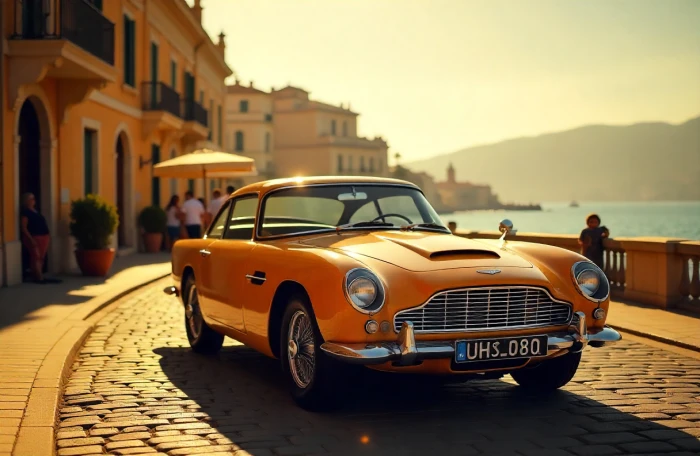


The James Bond car that defines the franchise is the Aston Martin DB5. But this status was never guaranteed. In Ian Fleming’s Goldfinger novel, Bond drove a DB Mark III, but the 1964 film introduced the newer DB5 instead. It gave the series something it had been missing, a car with the presence to match Bond’s image.
With its Silver Birch finish and restrained lines, the DB5 looked refined without losing its edge. It felt like a real grand tourer, not a futuristic prop. That first appearance reshaped the franchise. The DB5 has since appeared in eight Bond films, from Goldfinger to No Time To Die, reinforcing its role as the defining 007 vehicle.
Why The DB5 Was Already Special Before Hollywood
The DB5 would not have lasted this long on reputation alone. It was already a serious machine before it reached the screen. Built from 1963 to 1965, the DB5 refined the earlier DB4 with more power, improved comfort, and stronger long-distance capability. Its 4.0-liter dual-overhead-cam inline-six produced about 282 bhp and pushed the car to roughly 142 mph, placing it firmly among top-tier grand tourers of its era.
Production volume plays directly into today’s market. Aston Martin built just over 1,000 DB5s, including 887 saloons and 123 convertibles, a scale that remains small even by classic luxury standards.

The way the car was constructed matters just as much. The DB5 used Superleggera construction, a lightweight steel tube framework with hand-formed aluminum panels. This design improves agility but introduces long-term maintenance concerns. Corrosion can develop where aluminum meets steel, and repairing that damage requires specialized work. For collectors, that detail directly affects ownership cost and inspection priorities.
Performance That Still Commands Respect
The DB5 was built to cover distance quickly and comfortably. Most cars came with a ZF five-speed manual gearbox, which improved refinement and drivability compared to earlier transmissions.
The suspension setup focused on stability at speed rather than aggressive cornering. Independent front suspension and a live rear axle with a Watt’s linkage kept the car composed on long drives, which is exactly what buyers expected from a grand tourer.
The Vantage version pushed performance further. With Weber carburetors and revised camshafts, output climbed to roughly 314 to 325 bhp, and acceleration improved noticeably. Aston Martin built only 65 Vantage saloons, which explains why they carry a significant premium today.
The Gadgets That Changed Movie Cars Forever
The DB5 became a cultural icon when Q Branch equipped it with a suite of gadgets in Goldfinger. Revolving license plates, hidden machine guns, an oil slick, a smoke screen, tire slashers, and the ejector seat transformed it from a luxury car into something far more memorable.

The dashboard tracking system gave audiences an early vision of in-car navigation, long before that technology reached production vehicles.
These features did more than entertain. They reshaped expectations for what a movie car could be. The DB5 made the vehicle itself part of the story, not just a tool for getting from one scene to the next.
Low Production Is A Big Reason Values Stay High
The DB5 holds a rare position in the collector market. It combines low production numbers, strong engineering, and global recognition tied to the Bond franchise.
That combination shows up in pricing. A well-documented DB5 in strong condition typically sells between about $500,000 and $1.5 million. Cars connected to the Bond films reach another level entirely. One DB5 sold for $6.385 million at auction, reflecting both its provenance and its place in film history.
For buyers, these figures are not abstract. They influence insurance, storage, and transport decisions. A small difference in originality or documentation can shift value significantly.
Continuation Cars Kept The Legend Moving
Aston Martin revived the DB5 through its Goldfinger Continuation program, building 25 new examples using period-correct construction methods. Each car required roughly 4,500 hours of labor and included working versions of the film-inspired gadgets.
These cars were priced around $3.5 million and built primarily for collectors. They are not road legal in many regions due to modern safety standards, which limits how they can be used.
For enthusiasts, they offer something different from originals. They provide the experience of the DB5 without the same historical constraints, though they still require careful handling and storage.
The DB5 Still Shapes Aston Martin’s Image

The DB5 continues to influence Aston Martin’s design language and brand identity. The company’s DB12 Goldfinger Edition, limited to 60 units, draws directly from the original Bond-era styling, including Silver Birch paint and heritage-inspired interior details.
That connection shows how the DB5 still functions as a reference point. Modern Aston Martins are faster and more advanced, but they continue to reflect the same balance of performance and restraint that defined the DB5.
Why Shipping Matters More With A Car Like This
Transporting an Aston Martin DB5 requires more care than moving a typical vehicle. Hand-built aluminum panels, aging materials, and high market value create real risk during transit. Even minor damage can lead to expensive repairs or reduced value.
Enclosed carriers are usually the right choice for protecting the finish and structure. AmeriFreight Auto Transport works with collectors who need that level of care. Customer service agents help coordinate shipping based on the vehicle’s condition and route, and optional gap protection plans can provide an added layer of protection during transit. Get your quote now!
For a car in this price range, transport is a part of protecting the investment.
Why The DB5 Still Feels Bigger Than A Car
The Aston Martin DB5 continues to hold attention because it succeeds on several levels at once. It is a hand-built grand tourer with real engineering depth, a rare collector vehicle with strong market demand, and the most recognizable car in the James Bond franchise.
That combination is difficult to replicate. You can see it in auction results, continuation programs, and ongoing film appearances. The DB5 does not rely on nostalgia alone. It still works as a design, as a machine, and as a symbol.


.webp)