
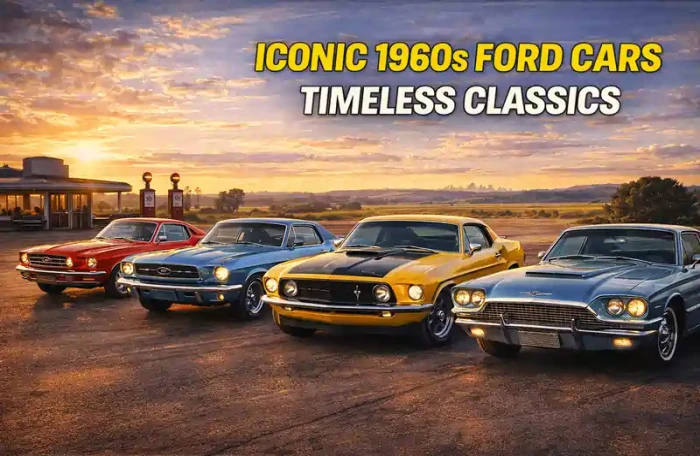


Iconic 1960s Ford cars still hold a strong place in American car culture because they came from a decade when Ford changed its identity. The company moved beyond conservative family transportation and leaned into performance, style, personal luxury, and racing credibility.
That shift mattered then, and it still matters now. Collectors often look at 1960s Fords through three lenses: originality, historical value, and long-term preservation. A Falcon, Mustang, Galaxie, Thunderbird, or F-Series truck may appeal for different reasons, but each one reflects a period when Ford was building vehicles for a changing country.

How Ford Reinvented Itself During The 1960s
Ford's 1960s lineup was shaped by a company-wide performance push often called the Total Performance era. The idea was simple: racing success could make Ford's showroom cars feel more exciting, more advanced, and more desirable.
This strategy gained force after Ford's failed attempt to buy Ferrari in 1963. After that deal collapsed, Ford committed major resources to building a racing program capable of winning on the world stage. The effort led to the GT40 program and helped sharpen Ford's image across its production lineup.
For buyers, this meant performance was no longer limited to specialized race cars. Ford brought stronger engines, sharper styling, better aerodynamics, and more aggressive trims into vehicles people could actually buy. The connection between racetrack credibility and dealership sales became one of the defining themes of the decade.
You can see that history reflected in Ford's official heritage materials and museum records, including The Henry Ford's coverage of the GT40 and Shelby racing programs.
The Ford Falcon Created The Foundation For Future Success
The Ford Falcon arrived for the 1960 model year as a practical answer to a changing market. Smaller imported cars were gaining attention, fuel economy mattered to more buyers, and many families wanted transportation that was affordable without feeling stripped down.
The Falcon used a lightweight unibody design and a simple mechanical layout, which helped keep costs low. Its standard 144-cubic-inch Mileage Maker six-cylinder engine could deliver up to 30 miles per gallon, making it an appealing choice for budget-conscious drivers.
Sales showed how well Ford understood the market. The Falcon sold about 435,000 units in its first model year, making it one of the most successful Ford launches of the period.
Its importance grew as the decade continued. The Falcon Sprint, introduced in 1963, added a 260-cubic-inch V8, a floor-mounted shifter, and sportier equipment. Those changes helped create the mechanical and market foundation for the Mustang.
For collectors today, the Falcon remains attractive because it is approachable, efficient, and easier to restore than many lower-production classics. Parts support is generally strong, and clean examples still carry the honest charm that made the car popular when new.
The Mustang Became A Cultural Phenomenon
The Ford Mustang debuted on April 17, 1964, at the New York World's Fair and quickly became one of the most important car launches in American history. It reached buyers who wanted a car that felt youthful, stylish, and personal without being priced out of reach.
Much of the Mustang's appeal came from its flexibility. A buyer could choose a basic coupe, a well-trimmed cruiser, or a V8-powered performance model from the same showroom. That wide range helped the Mustang connect with young professionals, families, and enthusiasts at the same time.
Ford sold more than 680,000 Mustangs during the model's first extended sales year. That number matters because it shows how strongly the car matched the moment. The Mustang offered image, choice, and value at a time when buyers wanted more from their cars than basic transportation.
The Mustang also helped define the pony car segment. Its long hood, short rear deck, available V8 power, and deep options list became a formula other automakers rushed to follow.

Shelby Turned The Mustang Into A Serious Performance Car
The standard Mustang was a sales success, but Ford wanted the car to carry real racing credibility. Carroll Shelby gave it that edge.
Shelby-American started with the Mustang fastback and transformed it into the GT350. The team upgraded the engine, suspension, brakes, and body components while removing unnecessary weight. The result was a Mustang that could compete seriously in Sports Car Club of America racing.
The GT350R pushed that idea even further. Only 36 racing versions were built in 1965, which makes original examples extremely valuable today. These cars used lightweight materials, deleted comfort features, and race-focused modifications that separated them sharply from ordinary street Mustangs.
By 1967, Shelby introduced the GT500 with a 428-cubic-inch Police Interceptor V8. Compared with the earlier GT350, the GT500 had a more mature personality. It delivered big-block power, but it could also be equipped with comfort features such as power steering, power brakes, and air conditioning.
That balance helps explain why Shelby Mustangs remain so desirable. They connect Ford's racing ambitions with cars that collectors can recognize instantly.
The Galaxie Proved Full-Size Fords Could Perform
The Galaxie showed that Ford's performance push was not limited to compact or mid-size cars. In the early 1960s, full-size cars still mattered deeply to American buyers, and Ford used the Galaxie to compete on the street, the drag strip, and NASCAR tracks.
The 1963½ Galaxie 500 R-Code is one of the clearest examples. It used a 427-cubic-inch FE-series V8 rated at 425 horsepower and 480 lb-ft of torque. Ford also revised the roofline into a sleeker fastback shape to reduce aerodynamic drag at higher speeds.
For racing, Ford built lightweight Galaxie versions with fiberglass panels, aluminum components, reduced trim, and stripped interiors. Those changes removed significant weight and made the cars far more competitive.
Collectors value these Galaxies because they combine size, rarity, and racing history. A clean Galaxie can be a strong collector car on its own, but documented R-Code and lightweight examples sit in a much more specialized market.
The Fairlane Grew Into A Muscle Car Favorite
The Fairlane began the decade as a practical family car, but it gradually took on a stronger performance role. Its size worked in Ford's favor. It was smaller than a Galaxie, roomier than a Falcon, and well suited for buyers who wanted usable power without moving into a full-size car.
By the mid-1960s, Fairlane GT and GTA trims gave the model real muscle car credibility. The available 390-cubic-inch V8 helped turn the Fairlane into a serious performance option while keeping it practical enough for regular driving.
Today, the Fairlane appeals to collectors who want 1960s Ford performance with a slightly different personality than the Mustang. It has strong period styling, good parts support, and enough trim variety to fit different budgets.
The Thunderbird Made Personal Luxury Feel Modern
While Mustang and Shelby models often get the most attention, the Ford Thunderbird played a major role in shaping the personal luxury market.
The third-generation Thunderbird, built from 1961 through 1963, earned the nickname "Bullet Bird" because of its sleek, jet-age styling. Its pointed front end, recessed headlights, and round taillights reflected the space-age design language of the period.
Inside, the Thunderbird offered features that made it feel more advanced than a typical family car. The 1961 model included the Swing-Away steering wheel, which moved to the side when the car was in Park to make entry and exit easier. Power came from a 390-cubic-inch V8 rated at 300 horsepower.
The fourth-generation Thunderbird, introduced for 1964, moved toward a more formal look. In 1965, Ford added sequential rear turn signals, which became one of the model's signature design details. By 1966, buyers could choose a 428-cubic-inch V8, giving the Thunderbird smooth and confident highway power.
For collectors, the Thunderbird offers a different kind of value. It is less about raw muscle and more about design, comfort, and period luxury.

The F-Series Earned Its Place Beyond The Job Site
Ford trucks also became more refined during the 1960s. The F-Series remained durable and practical, but Ford worked to improve ride quality and everyday comfort.
One major change was Twin I-Beam front suspension, introduced in the mid-1960s on two-wheel-drive F-Series trucks. This setup helped improve ride comfort while keeping the ruggedness truck buyers expected.
That combination made the F-Series useful for work, errands, and family life. Many surviving examples now attract collectors who appreciate clean design, simple mechanicals, and the honest character of a vintage truck.
For shipping and restoration planning, classic trucks deserve the same care as performance cars. Body panels, trim, glass, and original interiors can be expensive to replace, especially on well-preserved examples.
Rare 1960s Ford Models Still Draw Serious Interest
Some 1960s Ford cars became collectible because they were widely loved. Others gained value because they were unusual, short-lived, or tied to a specific design moment.
Ford Starliner
The Ford Starliner remains one of the most distinctive full-size Fords of the early 1960s. Its long, low roofline gave it a sleek fastback profile that looked more dramatic than many family cars of the period.
The Starliner's short production run adds to its appeal. Collectors often value cars that combine strong styling with limited availability, and the Starliner fits that pattern well.
Fairlane 500 Skyliner
The Fairlane 500 Skyliner technically belongs to the years just before the 1960s, but its influence carried into the decade. Its retractable hardtop was an engineering showpiece, with a complex folding roof system that still fascinates collectors.
Because Skyliners are more complicated than many cars of the era, condition and documentation matter a great deal. A well-sorted example can be impressive, while a neglected one can become expensive quickly.
The GT40 Strengthened Ford's Performance Image
The Ford GT40 was not a normal production car, but it shaped how people viewed Ford during the 1960s. It represented the most intense version of the Total Performance strategy.
Ford built the GT40 to win the 24 Hours of Le Mans, and the effort paid off in 1966 when Ford finished first, second, and third. That victory broke Ferrari's dominance and proved Ford could compete at the highest level of endurance racing.
The success continued. In 1967, the Ford Mark IV won Le Mans with Dan Gurney and A.J. Foyt behind the wheel. Later, chassis GT40P/1075 won Le Mans in both 1968 and 1969, making it one of the most historically important Ford race cars ever built.
The GT40 matters to this article because it changed the way buyers and enthusiasts saw Ford. It gave credibility to the performance image that surrounded Mustangs, Galaxies, Fairlanes, and Shelby models throughout the decade.
Originality Often Matters More Than Shine
Collector value depends heavily on condition, but originality can matter even more. A car with matching numbers, factory-correct trim, original equipment, and documented ownership history often carries more long-term appeal than a car restored without regard for accuracy.
That is especially true for rare models. Shelby Mustangs, R-Code Galaxies, Starliners, and high-spec Fairlanes can lose value when important parts are missing or poorly replaced. Even smaller details, such as factory badges, interior trim, original color combinations, and period-correct wheels, can influence buyer confidence.
Restoration quality also matters. A clean driver may be more enjoyable for regular use, while a concours-level restoration may suit a collector who wants show-quality presentation. Either way, documentation should stay with the vehicle. Receipts, photos, service records, ownership history, and restoration notes help tell the car's story.
Preservation Requires Planning Before A Car Moves
Transport is often part of classic car ownership. A buyer may need to move a new purchase across the country, send a vehicle to a restoration shop, or bring a car to a major show.
For valuable 1960s Ford cars, enclosed transport is usually the better choice. It helps protect paint, chrome, trim, glass, and weatherstripping from road debris and exposure during transit. Soft tie-downs and careful loading also matter, especially for restored cars, low-clearance vehicles, and models with delicate trim.
Before shipping a classic Ford, take detailed photos of the exterior, interior, engine bay, wheels, and undercarriage when possible. Remove loose items, confirm the vehicle's operating condition, and keep copies of key documents. These steps help reduce confusion and protect the car's condition record.
AmeriFreight Auto Transport works with customers who need to move classic vehicles and helps match shipments with carriers. For high-value classics, discussing enclosed transport and vehicle condition details ahead of time can make the process smoother. Get your quote now!
Why 1960s Ford Cars Still Matter
The most memorable 1960s Ford cars succeeded for different reasons. The Falcon gave buyers affordable efficiency when smaller cars were gaining ground. The Mustang captured a new generation of drivers. The Thunderbird made personal luxury feel modern, while the Galaxie and Fairlane showed how far Ford could push performance in familiar body styles.
At the top of the performance story, Shelby Mustangs and the GT40 gave Ford credibility that advertising alone could not create. Their racing success helped define the decade and gave collectors a deeper reason to value these cars today.
For owners, that history brings responsibility. A 1960s Ford is more than an old vehicle with chrome and a V8. It is a piece of American automotive history, and preserving its condition, documentation, and originality can protect both its value and its story.


.webp)