
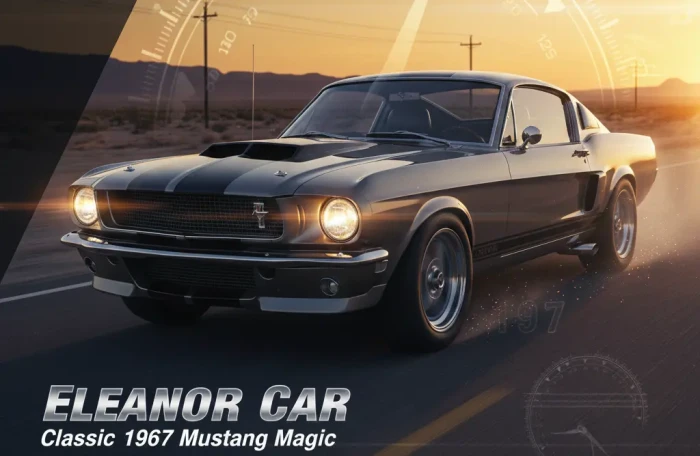


Explore the Eleanor Mustang, a 1967 Ford Mustang Fastback icon blending classic Shelby GT500 style with modern performance and real-world insights.
Eleanor Car: Classic 1967 Mustang Magic
The Eleanor Mustang occupies a space few cars ever reach. It is not treated like a typical classic. People expect it to deliver the visual drama of a film icon, the performance of a modern build, and the authenticity of a late-1960s muscle car all at once. That combination shapes how it is judged before anyone even turns the key.
Most recognize it from Gone in 60 Seconds, where the 1967 Ford Mustang Fastback became the foundation for a reimagined Shelby GT500. The work of Chip Foose and Steve Stanford gave the car a refined, deliberate identity rather than a purely nostalgic one. That shift did more than update a design. It reset expectations for what a Restomod Mustang could be.

From Toby Halicki to Hollywood Precision
The earliest version of Eleanor, tied to Toby Halicki, was never intended to define a category. It came together under tight constraints, with about 250 hours spent modifying the 1974 stunt Mustang into something that could hold up on screen.
Its impact came from what it did, not how it looked. The 128-foot jump remains one of the most recognizable moments tied to the car, reinforcing its reputation through action rather than polish.
By 2000, the approach had changed completely. Cinema Vehicle Services built between 11 and 13 cars to meet filming demands. Only three were fully functional “hero” cars designed for close-up shots and controlled driving. The rest handled stunts or specialized scenes. Today, roughly seven of those cars are confirmed to have survived.
That distinction explains a common misunderstanding. The Eleanor seen on screen was never a single vehicle. It was a coordinated group of builds, each serving a specific role.
The Foundation: What the Shelby GT500 Actually Delivered
The 1967 Shelby GT500 is often viewed as the perfect starting point. In reality, it was powerful but limited by the technology of its time. It used a 428 CID (7.0L) V8 with a factory-rated 355 HP. That output was impressive in its era, but handling, braking, and ride quality were still developing compared to modern standards.
This becomes clear when compared to contemporary Eleanor builds. Many now use a 351 Windsor crate engine or more advanced configurations. The improvement is not only in horsepower. It is in control, stable, and has overall drivability.
Some modern builds push output close to 1,000 HP. At that level, the car no longer behaves like its original counterpart. It becomes something entirely different behind the wheel.
Hero Car vs. Stunt Car Changes Everything
The distinction between a hero car and a stunt car is not only a production detail. It directly affects how an Eleanor build performs. Hero cars were finished to a higher standard, with attention to reliability and detail for filming. Stunt cars were reinforced for impact, often sacrificing refinement in favor of durability.
That difference still shows up in today’s market. Two cars can share the same Pepper Gray Metallic finish, identical proportions, and details like PIAA 959 driving lights. Underneath, one may feel balanced and usable, while the other feels rigid or difficult to manage in normal driving. Understanding that difference is critical before making any decisions.
The “Go Baby Go” System Isn’t What It Seems
The “Go Baby Go” button is one of the most recognizable elements tied to the Eleanor Mustang. It also carries a misconception. The film delivers a dramatic surge of speed. During production, it was purely visual. The cars did not rely on functional nitrous systems to achieve those scenes.
Modern builds sometimes include working setups. A typical configuration uses a 10-pound NOS bottle mounted in the trunk. This adds both performance potential and mechanical complexity. Some owners see it as essential to the car's identity. Others leave it out entirely. The decision depends on how the car will actually be used, not how it appeared on screen.

Pricing Reflects Priorities, Not Just Parts
Search results for a “1967 Shelby GT500 Eleanor for sale price” often feel inconsistent, and there is a reason for that. A verified movie car reached $1,000,000 at auction, driven largely by its history and connection to the film. That figure does not represent typical build costs.
Modern builds vary depending on goals:
Around $450,000 for high-end, fully customized builds from established shops.
Around $199,995 for more accessible builds from smaller specialists.
The variation comes down to priorities. Some buyers focus on accuracy and detail. Others prioritize performance and usability. Even technical choices influence value. Wheel dimensions, such as 17 x 8 inches, and axle ratios, such as 3.73 and 3.31, affect how the car drives, which in turn affects how it is perceived and priced.

The 2025 Ruling Changed the Landscape
For years, building an Eleanor-style car was subject to legal uncertainty. That changed in 2025. The Eleanor Mustang copyright ruling of 2025 clarified that the vehicle does not qualify as a protected character under the Towle character copyright test. This removed a major restriction on builders.
The result is a broader market. Buyers can now choose between independent builds and officially licensed Eleanor Mustang builder programs. That expansion comes with a tradeoff. Increased availability also means greater variation in quality, making careful evaluation more important than before.
Why Modern Builds Feel Like a Different Machine
Driving a modern Eleanor build feels nothing like driving a stock 1960s muscle car. The transformation comes from structural and mechanical improvements. Suspension upgrades, stronger braking systems, and reinforced chassis components allow the car to handle conditions that the original platform was never designed for.
Power figures often draw attention, but they are not the defining factor. The real change lies in how the car responds to steering input, manages weight transfer, and performs under braking. That combination creates a driving experience that blends classic styling with contemporary capability.
What Keeps the Eleanor Mustang Relevant
The Eleanor Mustang continues to matter because it does not fit neatly into one category. It presents the appearance of a 1967 Ford Mustang Fastback while delivering performance that aligns more closely with modern engineering. It carries the heritage of the Shelby GT500 but adapts it to current expectations.
That balance is difficult to achieve. When done well, it creates a car that is not just remembered for its role in Gone in 60 Seconds, but for how it redefined what a classic could become.
Shipping a Mustang with AmeriFreight Auto Transport
Shipping a 1967 Ford Mustang Fastback, especially an Eleanor-style build, involves more than basic transport. The value reflects craftsmanship, rarity, and often personal attachment.
AmeriFreight Auto Transport is one of the best-reviewed in the industry. Pricing is provided as a range rather than a fixed number, based on market conditions, route demand, and carrier availability. No upfront payment until you choose a carrier.
Carriers are not selected at random. Each one is vetted before being assigned, with attention to safety records, insurance coverage, operating history, and performance on similar routes.
Enclosed transport is often preferred for this type of vehicle. It limits exposure to weather and road debris, which matters for custom finishes and detailed components. Open transport remains a common option but offers less protection.


.webp)