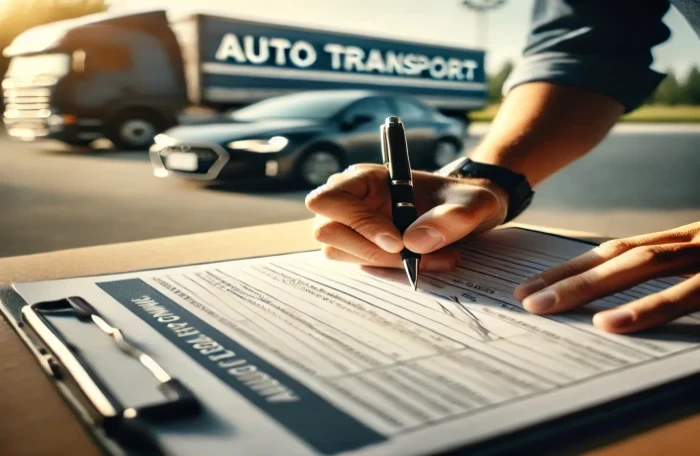


Auto Transport Bill of Lading: Everything You Need to Know
The Auto Transport Bill of Lading makes vehicle shipping tangible. It is not the quote or confirmation that determines what happens if something goes wrong. It is the moment a driver documents your vehicle’s condition that sets everything in motion.
This document sits at the center of vehicle shipping documentation. It carries legal and practical weight that most customers do not fully appreciate until there is a problem. The industry itself is large and growing, with vehicle transport projected to reach $485 billion globally by 2030. Still, disputes often come down to a few notes written during inspection.

What The Bill of Lading Actually Controls
At pickup, the Bill of Lading becomes the Contract of Carriage between you and the carrier. It also serves as Proof of Delivery later. These roles tie directly into the Carmack Amendment Liability, which governs how responsibility is assigned when damage occurs.
If a vehicle is recorded as undamaged at pickup and arrives with new issues, that difference becomes the basis of a claim. If the original record is incomplete or unclear, your position becomes harder to defend.
A common misunderstanding is assuming the broker carries responsibility throughout the shipment. In reality, the carrier has custody of the vehicle and issues the Bill of Lading. That distinction matters when questions of liability arise.
When working with AmeriFreight Auto Transport, customer service agents coordinate the shipment, but the carrier handling the vehicle controls the inspection and documentation process.
The Inspection Is The Entire Story
Most disputes stem from what happens during the initial inspection. The Vehicle wireframe inspection is where the driver records visible damage using a diagram, often supported by the AIAG Damage Coding System. This standardized method ensures that damage is described consistently.
If damage is not recorded at pickup, it is generally treated as pre-existing later. That makes the inspection the most important step in the process.
Around 80% of vehicle damage occurs during loading or unloading. Even though fewer than 5% of shipped vehicles report damage, the ones that do rely heavily on the accuracy of the Car Hauling Condition Report. This document becomes the foundation of any prima facie damage claim.
Rushing through the inspection creates gaps that are difficult to fix later. Taking a few extra minutes to verify every mark can make a meaningful difference if a dispute arises.
Delivery Is Where Claims Are Won or Lost
Delivery is often treated as the final step, but it is the last opportunity to verify everything. Before signing, you should carefully compare the vehicle’s condition against the original report. This is not a quick walkthrough. Lighting, angles, and surface reflections can hide or reveal damage depending on how closely you look.
If new damage is found, it must be written clearly on the Bill of Lading. Specific descriptions carry more weight than general statements. Signing a clean document confirms that the vehicle arrived without new issues. That single action can make it nearly impossible to pursue a claim later.
What Federal Rules Actually Require
The structure of the Bill of Lading complies with federal requirements outlined in 49 CFR § 373.101. These rules ensure that each shipment includes essential details such as the shipper and receiver, origin and destination, and a full description of the vehicle.
These requirements exist to prevent disputes and establish accountability. Missing or incorrect information can lead to delays, fines, or complications in resolving claims.
Carriers must also maintain a minimum of $750,000 in Carrier Liability Insurance for interstate transport. While this provides a baseline level of protection, actual coverage depends on the accuracy of the Bill of Lading.
Errors in documentation can have serious consequences. In some cases, incorrect classification or missing information can lead to penalties of up to $50,000.

Paper vs eBOL Auto Transport
Paper Bills of Lading are sometimes lost or misplaced. Replacing them can add unexpected administrative costs, and delays often significantly stretch payment timelines. Manual processing also takes time per load, and the time accumulates quickly across multiple shipments.
Electronic systems streamline this process. They reduce handling time and speed up payment cycles. These improvements can also lower overall shipping costs per load, especially when applied consistently across larger volumes.

The broader impact is significant. The trucking industry loses $11.5 billion annually in productivity due to detention, with $3.6 billion tied directly to delays such as paperwork processing. Managers spend an average of 8 hours each week handling administrative tasks related to documentation.
Adoption of eBOL Auto Transport is increasing steadily. Usage has grown from 1.2% in 2021 to about 11% by mid-2025. The global market for electronic Bills of Lading is expected to reach $9.6 billion by 2034, with potential savings of $6.5 billion annually and as much as $40 billion in additional trade volume enabled by digital systems.
Small Details That Quietly Change Risk
Several practical factors influence how smoothly a shipment proceeds. Fuel levels should remain around 1/4 of a tank. This reduces weight and helps maintain stable handling during loading and transport.
Vehicles must be able to roll, steer, and brake. If they cannot, additional equipment is required, which introduces more complexity and risk.
Personal items are another common concern. The DOT does not permit household goods inside transported vehicles. Some carriers allow limited items, often up to 100 pounds, for an additional fee. This must be discussed and approved in advance.
Electric vehicles follow the same process as traditional vehicles. There are no specialized hybrid-equipped carriers. Standard open or enclosed transport options are used.
Paperwork Errors That Cost Time and Money
The administrative costs of paper bills of lading in trucking are not just operational concerns. They directly affect timelines and outcomes. Even small mistakes can delay payments, create disputes, or trigger additional fees. Missing signatures, unclear notes, or incorrect vehicle descriptions can disrupt the entire process.
Detention and demurrage fees often begin with documentation delays. When paperwork is incomplete or missing, drivers may be forced to wait, and those delays carry financial consequences. These issues are rarely visible at the start of a shipment. They tend to surface later as delays, added costs, or complications in the resolution of claims.