


Meta description: Explore the top 1990s car brands that changed automotive history. From the dominance of the Toyota Camry to the radical design of the Dodge Viper, discover the icons of the decade.
Top 1990s Car Brands: Icons of the Decade
The 1990s shook up the automotive world. Buyers stepping onto dealership lots at the dawn of the decade were tired of the compromises from the previous era. The late 1970s and 1980s had forced manufacturers to downsize rapidly due to global oil shocks, leaving a market flooded with utilitarian vehicles that prioritized fuel economy ahead of performance and build quality. The Oldsmobile Cutlass and Chevrolet Cavalier had been popular, but consumers were increasingly focused on long-term reliability. This shift set the stage for a highly competitive period that changed consumer expectations forever.

Escaping the Malaise Era: The Demand for Measurable Quality
Consumers in the early 1990s began to alter their purchasing criteria. They started looking closely at reliability and ergonomics rather than relying on historical brand loyalty. Buyers wanted interiors that held up over time and engines that didn't require constant maintenance. Japanese manufacturers recognized this shift and delivered vehicles that prioritized objective, long-term durability.
Honda: Engineering the New Standard
Honda met these changing consumer needs with the Accord. The vehicle grew to mid-size stature for the 1990 model year, addressing the American consumer's preference for interior space and highway cruising comfort while maintaining fuel efficiency. The Accord quickly became the best-selling passenger car in the United States. It opened up a massive sales lead against its closest domestic rivals and held the top spot securely through 1991.
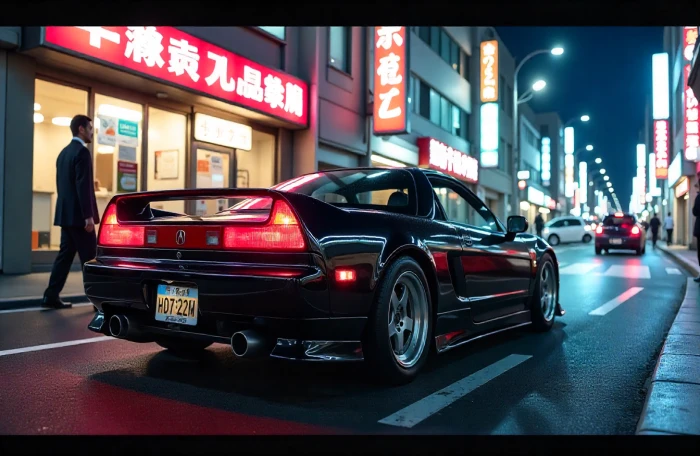
Honda then applied this philosophy of reliable engineering to the sports car market through its Acura division. Introduced in August 1990, the 1991 Acura NSX prompted traditional European supercar manufacturers to evaluate their approach to vehicle design. Prior to the NSX, exotic cars were known for being temperamental, often featuring poor ergonomics and frequent maintenance needs.
The NSX was a significant engineering achievement. It was the first production car to feature an all-aluminum chassis. The bare unit-body construction weighed 462 pounds, noticeably less than a steel equivalent. The vehicle utilized a 3.0-liter V-6 engine that introduced VTEC technology to the US, built with titanium connecting rods. Producing 270 horsepower, the NSX achieved 0-60 mph in under six seconds. Honda demonstrated that a mid-engine sports car could be as reliable and comfortable as a daily commuter, with a base price of $65,000.

Ford: The Mainstream Counteroffensive
Ford initiated a major internal effort to reclaim the passenger car market. The automaker established a mandate requiring the Ford Taurus to feature a space-efficient front-wheel-drive architecture. Engineers benchmarked the ride and handling of upscale European luxury sedans with the goal of delivering capable chassis dynamics at a middle-class price point.
The updated second-generation Taurus was highly successful. Supported by dealer promotions and fleet sales, it unseated the Accord to become the top-selling car in America for five consecutive years.
However, mainstream sedan buyers proved to have specific preferences. A rounded, ovoid redesign for the third-generation Taurus in 1996 was poorly received by the market. Consumers generally rejected the new styling, and the model subsequently lost significant market share.
Toyota: Quiet Competence and Over-Engineered Thrust
Toyota capitalized on the changing market dynamics efficiently. The Toyota Camry built its reputation by prioritizing a quiet cabin and consistent build quality. It ultimately overtook the Taurus in the late 1990s to claim the top sales spot. The Camry eventually surpassed a total of more than 11.9 million lifetime sales in the US, indicating that mainstream buyers valued conservative reliability.
Toyota also made a significant impact in the sports car segment with forced induction. The 1993 Toyota Supra Turbo featured the 2JZ-GTE engine. This 3.0-liter sequentially twin-turbocharged inline-six produced 320 horsepower and 315 lb-ft of torque. The system was designed to provide low-RPM responsiveness from the primary turbocharger, followed by increased power when the secondary turbocharger engaged, allowing a 4.6-second sprint to 60 mph.
The Mk4 Supra carried a curb weight of 3,417 pounds while maintaining a near-perfect 51/49 weight distribution and utilizing an advanced ABS system. The structural integrity of its cast-iron engine block later became famous for handling significant aftermarket modifications.

The Philosophy of Speed: Shifting Performance Paradigms
Away from the practical needs of the mainstream sedan market, engineers treated sports cars as blank canvases for opposing performance philosophies. Japanese brands leaned into complex electronics and lightweight rotary engines, while American automakers doubled down on structural rigidity and massive displacement.
Mazda and Nissan: Rotary Purity vs. Technological Tour de Force
Mazda and Nissan expanded the Japanese performance footprint using two completely different approaches. Mazda introduced the third-generation RX-7 (FD) in 1993 with a tiny 1.3-liter twin-rotor Wankel engine. By pairing this unconventional, small-displacement rotary engine with a complex sequential twin-turbocharger system, Mazda managed to squeeze out 255 horsepower in a chassis famous for its strict weight reduction and handling purity.
Conversely, the Nissan 300ZX (Z32) twin-turbo variant utilized a heavier 3.0-liter V-6 engine producing 300 horsepower. It incorporated advanced electronics like the Super HICAS four-wheel steering system to artificially improve cornering grip, providing a distinct technological alternative to the lighter RX-7.
Dodge: Unfiltered American Performance
Conceived as a modern take on the classic Shelby Cobra, the 1992 Dodge Viper RT/10 was a deeply unfiltered machine that ignored every rising trend of the decade. Driving an early Viper was a raw, analog experience because Dodge refused to include air conditioning, exterior door handles, side windows, traction control, or anti-lock brakes.
The Viper was powered by an 8.0-liter V-10 engine generating 400 horsepower and 465 lb-ft of torque. Featuring a tubular steel frame and wide Michelin rear tires, the Viper required immense focus from its driver. It could accelerate to 60 mph in 4.5 seconds. Its side-exit exhaust pipes and raw driving mechanics offered a distinct experience compared to refined Japanese sports cars. Production was extremely low, with Dodge building only 285 units in that inaugural 1992 model year.

Chevrolet: A Structural Revolution
Chevrolet approached performance with structural updates. The release of the fifth-generation C5 Corvette marked a turning point in the model's engineering, directly addressing the notorious cowl shake that affected its predecessor. The C5 debuted a rear-mounted transaxle to achieve a perfect 50/50 weight distribution, vastly improving cornering stability.
The standard C5 utilized a new 5.7-liter all-aluminum LS1 V-8 engine producing 345 horsepower. The track-focused 2002 Z06 variant increased this to 405 horsepower while dropping the curb weight to 3,118 pounds by using a titanium exhaust system, thinner glass, and a lighter battery. This resulted in strong lateral grip and a 4.0-second sprint to 60 mph.
The Emergence of the Lifestyle Vehicle
As the decade progressed, a massive shift occurred in how consumers selected their daily drivers. Buyers started prioritizing cars that reflected their personality, seeking out bold designs that sparked nostalgia or tied into popular culture.
Volkswagen and BMW: Cultivating Infatuation
The Volkswagen New Beetle launched at the 1998 Detroit Auto Show and quickly became a cultural talking point. The original air-cooled Beetle had sold more than 21.5 million units globally, creating a strong sense of nostalgia. The modern front-wheel-drive package translated the rounded silhouette of the original while utilizing the PQ34 platform shared with the Golf.
The public reaction was strong, with the pre-launch website registering more than 1.2 million hits. It sold 55,842 units in the United States in 1998 before increasing nearly 60 percent to 83,434 units in 1999. The sales figures proved that leveraging retro design was a highly effective strategy.
BMW took a different path to generate interest. Their introduction of the Z3 roadster for the 1996 model year involved notable product placement. It was the first BMW vehicle assembled entirely in the United States. It was promoted through a partnership with MGM Studios, featuring the vehicle prominently in the 1995 James Bond film "GoldenEye." A special James Bond Edition Z3 was offered through the Neiman Marcus catalog for $35,000, and the 100 exclusive units sold out in two days. The initial production run of 15,000 standard Z3 roadsters also sold quickly.
Subaru and the Crossover Genesis
While the sports car and lifestyle markets grabbed headlines, a much quieter structural revolution was taking place. By 1995, consumers were showing a preference for the rugged aesthetics and higher seating position of traditional SUVs, but they actively disliked the poor fuel economy and rough ride associated with truck-based frames.
Subaru solved this problem by combining the best traits of both vehicle types. By taking their existing station wagon platform and lifting the suspension to achieve 7.8 inches of ground clearance, they created the 1995 Subaru Outback. The marketing campaign emphasized that the Outback offered poor-weather traction while retaining the driving dynamics of a passenger car. The Outback was a notable sales success. It helped pioneer the modern unibody crossover segment and went on to sell more than three million units, permanently shifting the market away from traditional sedans.


.webp)