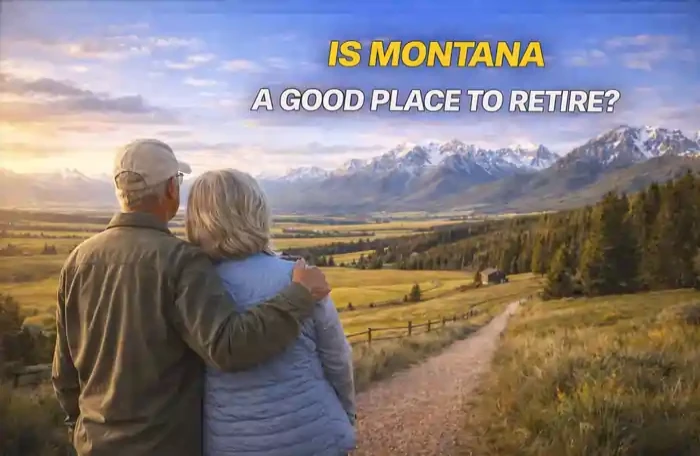


Yes, Montana can be a good place to retire. Each year, more people look toward Big Sky Country for its open land, small towns, and slower pace. Still, not every Montana town fits every lifestyle, budget, or long-term plan.
Some people want mountain views and access to trails. Others care more about healthcare, housing costs, or being close to family. You might love the energy of Bozeman but feel uneasy about rising home prices. You might like the calm of a rural town yet worry about winter travel or services.
This guide helps you sort through those choices.
What You’ll Learn
The pros and cons of retiring in Montana
The notable retirement spots retirees consider before settling in Big Sky Country
The frequently asked questions retirees ask about living in Montana
Summary
Pros of Retiring in Montana

Financial Benefits
Living in Montana means experiencing no statewide sales tax. The state is one of only five U.S. states with no general sales tax on purchases, along with Alaska, Delaware, New Hampshire, and Oregon. Small towns in Montana also often have cheaper housing and living costs than the US average.
The table below shows the average home prices of these communities compared to the rest of the country:
Source: 2026 Zillow data
These financial benefits help you:
Leave more money for other expenses: These include food and travel.
Retire on a fixed income: This is especially helpful if you rely on Social Security or pensions.
Outdoor Lifestyle
Montana offers numerous ways to explore the great outdoors. Some of these include the Rocky Mountains and Glacier National Park. The natural beauty gives you easy access to hiking, fishing, and skiing. Quiet forests, clear lakes, and big open skies help you rest and enjoy nature.
Other natural attractions include:
Flathead Lake State Park: It sits on Flathead Lake and has views of the Montana mountains, Mission and Swan Range.
Lake McDonald: One of the most visited of the Montana lakes. It sits in Glacier National Park. The lake is long and deep and lies in a valley surrounded by high peaks.
Community
Many small towns in Montana contain friendly and tight-knit communities where people know each other and look out for one another. Many have a large senior population and social events that help you feel at home.
Some of these community gatherings include:
Chokecherry Festival: Lewiston residents celebrate a fall tradition through a parade, seed spitting contest, 5k and 10k runs, pancake breakfast, local food booths, and craft vendors.
Huckleberry Day Arts Festival: Whitefish residents celebrate the summer spirit with arts and crafts, food booths, and contests.
Healthcare
Montana offers access to quality medical care throughout the state. Some of these top-rated healthcare systems include:
Bozeman Health Deaconess Hospital: Through its Geriatric Medicine program, older adults have access to specialty care for chronic conditions and other age-related needs. The hospital is located in Bozeman.
Billings Clinic: Through its Geriatric Care program, seniors have access to comprehensive primary care, detailed health evaluations, screenings for age-related syndromes, and links to community support resources.
Cons of Retiring in Montana

Taxation
Montana taxes most forms of retirement income, including Social Security benefits, 401(k) withdrawals, pension payouts, and IRA distributions as part of your state income. The amount you pay depends on your total income under Montana’s graduated tax rates.
Managing this may involve:
Working with a tax professional: They can help you build a customized financial plan.
Timing withdrawals: Spreading withdrawals over years may reduce state tax.
Cost
Popular towns like Bozeman and Whitefish come with higher costs for housing and daily life. Bozeman’s living costs run well above average. Housing there alone is 65 percent more than the rest of the country. Whitefish home prices are even higher, at 80 percent more than the national average.
The table below shows how expensive some average housing costs are in different towns throughout Montana versus the rest of the country:
Source: 2026 Zillow data
To handle higher home prices, you can:
Choose a smaller property: A smaller house or condo costs less to buy and maintain.
Plan your budget around overall living costs: Housing is only one part of your budget. You can access statewide support through organizations such as Area Agencies on Aging.
Climate
Summers in Big Sky Country can be warm and dry. This dries out forests and grasslands and raises the risk of Montana wildfires.
The state’s winters, meanwhile, can be long, cold, and snowy. Roads in rural areas may get icy or hard to drive. This can affect travel to appointments or errands in winter months.

Preparing for the Montana climate may mean:
Monitoring state and local emergency alerts: Sign up for alerts from Montana Disaster & Emergency Services and local counties.
Winterizing your vehicle: Some things you can do include installing winter tires, checking battery and fluid levels, and adding freeze-resistant washer fluid.
Jobs
Part-time work is harder to find outside big cities in Montana. Most openings in rural towns are in retail, food service, delivery, or seasonal jobs, which can be limited and competitive compared with places like Missoula or Billings.
You can deal with this by:
Accessing Job Service Montana: These workforce centers help you search for local openings, build resumes, practice interviewing, and connect with employers in your area.
Explore national programs: One of these is the Senior Community Service Employment Program. It offers part-time work and training help for adults seeking community service roles while earning income.
Notable Retirement Spots in Montana

Deer Lodge
Deer Lodge, one of the most affordable places to retire in Montana, is a quiet, historic small town nestled in a wide valley with views of surrounding mountain ranges and ranchland.
Population: ~3,006
Average home price: $274,933
Notable attractions: Grant-Kohrs Ranch National Historic Site, Montana Auto Museum
Lewistown
Lewistown sits near the geographic center of the state in the rolling Judith Basin with views of five mountain ranges all around. Its strong local culture shines through community traditions such as the Chokecherry Festival, making it one of the best towns to live in Montana.
Population: ~6,204
Average home price: $273,523
Notable attractions: Central Montana Historical Museum, Big Springs Trout Hatchery & Park
Glendive
Glendive is a small town set where the Yellowstone River meets the rugged badlands of eastern Montana.
Population: ~4,760
Average home price: $186,245
Notable attractions: Glendive Dinosaur and Fossil Museum, Makoshika State Park
Hamilton
Hamilton is a charming small town in the scenic Bitterroot Valley framed by the Bitterroot and Sapphire Mountains. You can stroll its historic downtown with local shops, farms, and a lively farmers market.
Population: ~5,383
Average home price: $512,386
Notable attractions: Daly Museum, Ravalli County Museum & Historical Society
Whitefish
Whitefish sits at the edge of the Northern Rocky Mountains and on the shores of Whitefish Lake, offering both scenic water views and a walkable, historic downtown with shops, cafes, galleries, and local eateries to explore.
Population: ~9,256
Average home price: $840,304
Notable attractions: Dick Idol Signature Gallery, Whitefish Lake State Park
Final Thoughts: Retiring in Montana
Choosing Montana for retirement means experiencing a mix of scenic landscapes, small-town life, and practical considerations that shape daily living. From mountain valleys to prairie towns, each place feels different.
Whether you prefer quiet routines or active days outdoors, Big Sky Country gives you room to plan a retirement that fits your pace comfortably.
Move Your Car to Big Sky Country with AmeriFreight
Let AmeriFreight Auto Transport handle your vehicle shipment before you settle into Montana’s mountain towns, river valleys, and wide open plains. Our agents work with licensed carriers nationwide to support a smooth move, whether you are heading to Bozeman, Missoula, Billings, Whitefish, or a quieter small town.
With more than two decades of experience, AmeriFreight Auto Transport helps your vehicle arrive in Montana safe and ready for daily driving, medical visits, and life in Big Sky Country.
Frequently Asked Questions (FAQs)
How has the ‘Yellowstone’ effect impacted housing prices for retirees in the Bitterroot Valley?
The hit show Yellowstone helped draw national attention to Montana. In the Bitterroot Valley, recent reports show average listing prices now over $700,000 in communities like Hamilton.
Which Montana retirement communities offer the best walkable access to fly-fishing and hiking trails?
Many cities across Montana counties, such as Whitefish in Flathead County and Bozeman in Gallatin County, place you near hiking trails and prime fly-fishing rivers like the Smith and Madison.
Is the air quality in western Montana significantly affected by forest fire smoke during the summer?
Yes, Western Montana’s air quality often worsens in summer when wildfire smoke drifts into valleys. Smoke can trap in bowl-shaped terrain and raise fine particle levels, making air unhealthy or worse on some days during peak fire season.
Which Montana cities have the best access to specialized geriatric care?
Populous places in Montana, like Bozeman and Billings, give you strong access to specialized geriatric care with programs that focus on older adult health and coordination of age-related needs.
Disclaimer
The information provided in this guide is for general informational purposes only and does not constitute legal, financial, or professional advice. While efforts have been made to ensure the accuracy and timeliness of the content, laws, regulations, and local conditions are subject to change without notice.
Readers should not act upon this information without seeking appropriate professional counsel, especially in financial and legal matters.


.webp)