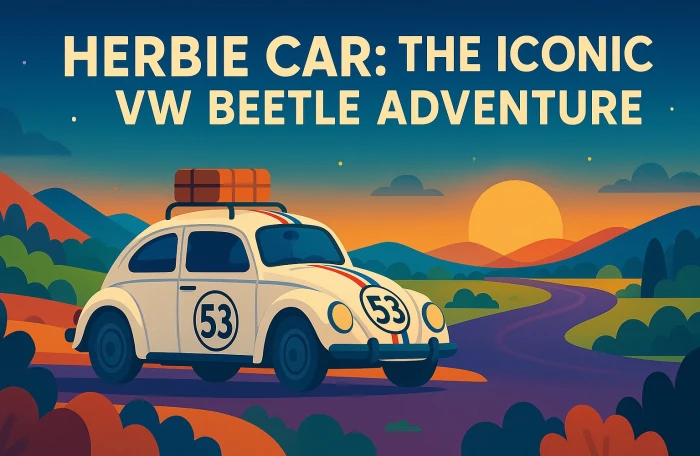


Herbie: The Legendary VW Beetle's Iconic Adventure
The Herbie car works because it feels alive in a way most vehicles never do, and that connection comes from a very deliberate idea rather than nostalgia alone.
Writer Gordon Buford first explored that idea after noticing how people treated cars with the same care they gave working animals, and Disney turned that observation into The Love Bug, a film that stood apart in an era dominated by loud, powerful muscle cars. Instead of competing on size or speed, Herbie leaned into personality, which made the character immediately memorable.
The Beetle Was Chosen for a Reason
The Volkswagen Beetle was selected after a simple but telling test on the Disney lot, where several compact cars were placed in front of employees to observe how people reacted to them.
Most vehicles were treated like machines, inspected or ignored, but the Beetle drew a completely different response, as people instinctively smiled and reached out to touch it, which confirmed it could be accepted as a character rather than just a prop.

That instinctive reaction still explains why Herbie remains recognizable today, since the Beetle’s shape already felt approachable, and the films simply gave that design a personality people could connect with.
The Look That Made Herbie Famous
A proper Herbie replica depends on precision, since even small visual mistakes quickly break the illusion for anyone familiar with the films.
The original car is widely identified as a 1963 Volkswagen Beetle Deluxe Sunroof Sedan finished in L87 Pearl White, with red, white, and blue racing stripes running across the body and over the canvas sunroof. The number 53 ties back to baseball pitcher Don Drysdale, while the OFP 857 license plate carries a reference to Disney production history.
Each of these details reinforces the identity of the car, and missing or altering even one element, such as stripe proportions or wheel style, tends to make a build feel more like a themed Beetle than a faithful Herbie.
What Counts as an Authentic Herbie
Most Herbie cars fall into three clear categories, and the differences matter when it comes to value and expectations.
Fan builds are the most common and vary widely in accuracy, while licensed replicas follow stricter standards and tend to hold more consistent value. Screen-used cars sit at the top of the market, where documentation and verified history define their worth and separate them from even the best replicas.
For buyers and builders focused on accuracy, a few details consistently matter most:
A 1963 Beetle with a ragtop sunroof
Correct placement and styling of the number 53
Proper stripe width and alignment
Whitewall tires paired with chrome VW hubcaps
A simple interior that avoids modern upgrades
These elements tend to hold up under close inspection and define whether a car feels authentic rather than approximate.
Herbie Was Faster Than He Looked
On screen, Herbie competes with high-performance cars, which required far more than a stock Beetle could deliver.
Disney solved this by building multiple versions of the car, each designed for a specific purpose, including stunt work, close-up shots, and high-speed sequences. Some cars were upgraded with a Porsche 356 Super 90 engine, while others handled specialized effects such as hidden rear-seat driving controls or mechanical setups that created Herbie’s signature wobble.
That approach allowed the filmmakers to create movement and personality without relying on digital effects, which is why the character still feels convincing decades later.

Building a Replica Starts With the Right Donor Car
A successful Herbie build depends heavily on the starting point, and the donor vehicle determines how much work lies ahead.
The 1963 Beetle remains the closest match, although models from 1960 to 1967 can work when the structure is sound and the body lines are consistent with the original look. Structural condition matters more than appearance at this stage, since rust in critical areas like the frame or rear quarters can significantly increase costs and delay the project.
Once the base car is solid, the process shifts toward details, including accurate decals, correct wheel choices, and proper sunroof configuration, all of which contribute to how convincing the final result appears.
DIY or Custom Shop Depends on Your Goal
Choosing between a DIY build and a professional restoration shop usually comes down to time, experience, and expectations.
A DIY approach offers control over the process and budget, but it often stretches timelines and introduces challenges in sourcing accurate parts or achieving consistent finish quality. A professional shop, especially one experienced with Volkswagen restorations, can streamline the process and deliver a more polished result, particularly when the goal is a film-accurate replica rather than a general tribute.
That difference becomes clear in the final details, where paintwork, stripe alignment, and interior choices determine whether the car feels complete.
Herbie’s Value Comes From More Than the Movies
The Volkswagen Beetle already had a strong place in automotive history before Herbie appeared, having reached massive global production numbers that made it one of the most recognizable cars in the world.
The films added personality to that familiarity, which helped the franchise expand into multiple films and television projects and eventually earn recognition through preservation efforts tied to the Library of Congress.
That combination of cultural recognition and automotive history is what gives Herbie lasting value in the collector market.
The Market Rewards Documentation
Collector interest in Herbie cars depends heavily on proof, since documentation separates a valuable example from a well-executed replica.
Even standard Beetles have an established value range, tracked through sources like Hagerty’s valuation data, but verified screen-used cars or highly accurate builds with strong records tend to command significantly more attention.
That makes paperwork, restoration records, and build accuracy just as important as appearance when evaluating a Herbie.
Keeping the Car Looking Right

Maintaining a Herbie requires attention to detail, since the simple design makes wear and damage easy to spot.
Hand washing helps preserve decals and paint, while indoor storage or UV protection reduces fading and surface wear over time. Chrome components benefit from gentle care rather than aggressive polishing, which can introduce visible imperfections that stand out against the clean design.
Consistent maintenance keeps the car aligned with its intended look and protects the work invested in the build.
Why People Still Care
Herbie continues to resonate because the character was built around relatability rather than performance, which gives it a broader appeal than most movie cars.
The Volkswagen Beetle provided a familiar foundation, and the films added personality in a way that still feels natural decades later. That combination keeps Herbie relevant, whether someone is restoring a replica, collecting film history, or simply recognizing the car from across the street.
Moving a Herbie Without Risking the Finish
Transporting a Herbie involves more than moving a standard vehicle, since custom paint, decals, and older materials are more sensitive to exposure.
Enclosed transport reduces the risk of debris and weather damage, which helps maintain both appearance and long-term value. AmeriFreight Auto Transport works with customers moving classic vehicles, and customer service agents coordinate carriers familiar with handling older cars.
Optional gap protection plans are also available, which adds another layer of consideration when planning a shipment. Request a quote now!


.webp)