
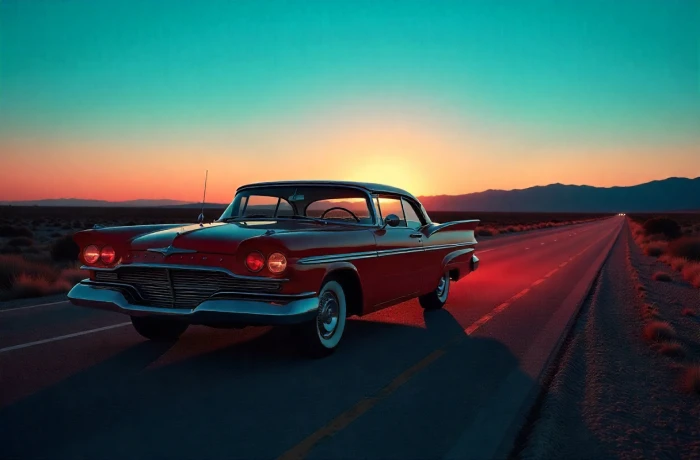


Christine’s Terror: 1958 Plymouth Fury Unleashed!
Most cars fade into the background of daily life, but Christine refuses to do that.
Stephen King took a real machine, the 1958 Plymouth Fury, and turned it into something that feels alive, controlling, and dangerous. That idea works because the car itself already carried a strong presence long before it appeared on screen. It was never subtle, and that made the transition into horror feel believable.
Arnie Cunningham’s story lands harder when you recognize the pattern behind it. Isolation turns into attachment, and attachment slowly becomes dependence. The car fills a gap at first, then replaces everything else that once mattered.
The Real 1958 Plymouth Fury Was Built to Stand Out
The Fury did not start as a horror prop. It was designed to change how people saw Plymouth.
In the mid-1950s, Chrysler moved away from conservative styling and pushed toward something more aggressive and forward-thinking. Virgil Exner’s “Forward Look” design language reshaped the entire lineup, emphasizing cars that were longer, lower, and wider, with proportions inspired by aerospace design.

Plymouth marketed this shift with the claim that its cars were years ahead of the competition. That ambition shows clearly in the 1958 Fury. The low 53.5-inch height, long hood, and short rear deck created a stance that looked fast even when parked.
That design was not just about appearance. It was meant to reposition Plymouth from practical and predictable to bold and performance-driven.
Performance That Matched the Look
The Fury backed up its design with serious hardware for its time.
The standard 318 cubic inch V8 produced 290 horsepower, while the optional 350 cubic inch “Golden Commando” engine pushed output to 305 horsepower with strong mid-range torque. With the top engine, the car could reach 60 mph in about 7.7 seconds, which placed it ahead of many competitors in the late 1950s.
Fuel delivery played a role in that performance. Both engines used dual four-barrel carburetors, effectively creating an eight-barrel setup that delivered strong acceleration through the mid-range.
There was even an early attempt at electronic fuel injection using a Bendix system. It promised higher output but proved unreliable in real-world use, leading most cars to be converted back to carburetors.
That mix of ambition and limitation reflects the era. Engineers were pushing boundaries, but the supporting technology had not fully caught up.
Engineering That Changed How the Car Drove
The Fury’s engineering gave it a distinct advantage on the road.
Chrysler’s Torsion-Aire suspension replaced traditional coil springs with longitudinal torsion bars, lowering the center of gravity and improving overall stability. This design reduced body roll and helped maintain better tire contact with the road, especially during cornering and braking.

The system also introduced anti-dive geometry, which limited the front-end drop during hard braking. That kept the car more level and controlled under sudden deceleration .
Oriflow shock absorbers further refined the ride by managing how the car absorbed road impacts. Together, these components gave the Fury a level of handling stability that stood out in its class.
The push-button TorqueFlite automatic transmission added to that experience. Its placement beside the dashboard reinforced the car’s futuristic feel while delivering smooth, consistent power through its three-speed design.
Design Details That Translate Into Fear
The film did not need to exaggerate the car’s design. It used what was already there.
The wide grille and quad headlights form something that resembles a face, while the tailfins extend outward like blades. Chrome trim highlights every edge, making the car’s shape more defined under light.
The proportions do the rest. A long hood, short rear deck, and low stance give the car a grounded, almost immovable presence.
In reality, the 1958 Fury was only offered in Buckskin Beige with gold trim, a combination that emphasized refinement. The film’s switch to a red body with a white roof transformed that same design into something far more aggressive and visually dominant.
The underlying design stayed the same. The context changed how it was perceived.
Inside the Fury: A Space-Age Interior
The interior matched the exterior’s forward-thinking design.
Drivers sat behind a wraparound windshield that improved visibility and added to the sense of openness. The dashboard featured a clean, horizontal layout with integrated controls and a push-button transmission interface.
One of the more unusual features was a built-in dashboard clock designed as a “self-regulating” watch, which reflected the era’s focus on precision and innovation.
Materials also reinforced the car’s identity. Upholstery combined cloth and metallic-thread accents, while the color palette stayed within coordinated beige and gold tones to match the exterior.
The result felt more like a controlled cockpit than a traditional car interior.
How Hollywood Brought Christine to Life
By the early 1980s, original 1958 Plymouth Furys were already difficult to find. Production teams gathered roughly two dozen cars, including Belvederes and Savoys, and modified them to match the Fury’s appearance.
Each vehicle served a specific role. Some handled standard driving scenes, while others were built for destruction.
The self-repair scenes relied on practical effects. Crews used mechanical systems to pull damaged panels inward, then reversed the footage so the car appeared to heal itself.
Sound design added another layer. The engine audio came from a larger Ford V8, giving Christine a deeper and more aggressive tone than the original engine produced. These choices grounded the supernatural elements in real, physical effects.
Why the Story Feels So Real
Stephen King chose a car that people did not already associate with prestige or nostalgia.
The 1958 Plymouth Fury was distinctive but not widely recognized, which made it believable as something overlooked before becoming central to the story.
As Arnie restores the car, the transformation feels gradual and grounded. The car improves, and his confidence grows, but the relationship shifts into something controlling.
That progression mirrors real behavior. Obsession rarely starts with consequences. It builds quietly, then replaces everything else.

Rarity, Value, and What Survived
The Fury’s limited production was only part of the reason it became rare.
The 1958 recession reduced demand, and quality issues like corrosion and structural wear affected long-term durability. Many cars did not survive decades of use, which reduced the number of remaining examples .
Authentic movie cars have sold for more than $275,000, reflecting both their rarity and their connection to the film. Standard models in strong condition can still command significant prices depending on originality and documentation.
Documentation matters. Many replicas exist, often built from similar Plymouth models and modified to match the film version, which makes verification essential.
A small number of known survivors remain in museums and private collections. Some were nearly scrapped after filming before being restored, which adds to their historical significance.
Collectors tend to fall into two groups. Some preserve the original factory appearance, while others recreate the film version in detail. Both approaches reflect the same lasting appeal.
Shipping a Classic Like the Fury Requires Planning
Transporting a car like the 1958 Plymouth Fury requires careful planning.
Older vehicles often have fragile trim, aging seals, and components that are difficult to replace, which increases the risk during transport. That risk becomes more significant as the vehicle’s value and rarity increase.
Enclosed transport reduces exposure to weather and road debris, which helps protect the vehicle throughout the journey.
AmeriFreight Auto Transport helps coordinate that process by connecting you with carriers experienced in handling classic and specialty vehicles. Customer service agents walk through timing, transport options, and key details so you can make informed decisions. Get your quote now!
Disclaimer: This article is for informational and entertainment purposes only. The Christine Car is a fictional vehicle from a film, and while some replicas exist, they are not affiliated with the original creators or licensed properties. Any references to custom builds or fan-made projects are based on publicly available information and are not endorsements. Always consult a qualified professional before attempting any automotive modifications or large-scale vehicle builds.


.webp)