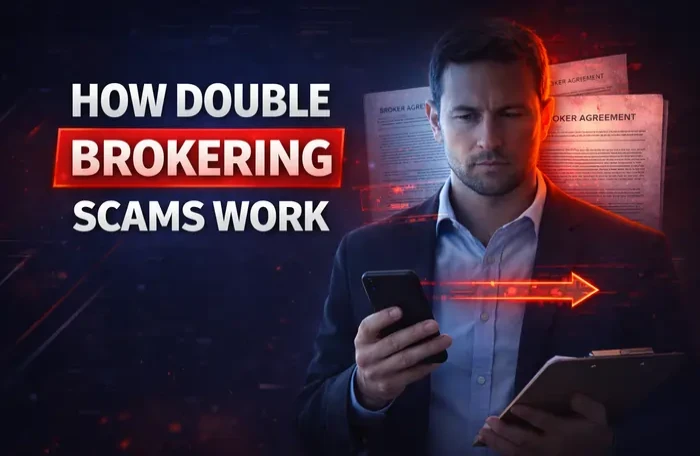


At its core, double brokering happens when a party accepts a load as a carrier and then secretly hands it to someone else without permission. Sometimes that second handoff is sloppy and opportunistic. Increasingly, it is deliberate, organized, and designed to disappear with the money.
Double brokering scams thrive in the space between paperwork and reality. On paper, a load looks properly assigned. In the real world, the truck hauling it often has no contractual relationship with the party paying for the move. That gap is where fraud lives.
According to data compiled by the Transportation Intermediaries Association, unlawful brokerage now represents the most frequently reported freight fraud scheme, following a sharp rise in overall incidents since 2021.
Many people assume this only affects large commercial shippers. That assumption is wrong. Any transport transaction that relies on trust, speed, and remote verification can be pulled into the same pattern, including vehicle shipments arranged through brokers such as AmeriFreight Auto Transport.
Why the Scam Keeps Working
The logistics industry was built on trust. A shipper hires a broker. The broker hires a carrier. The carrier delivers the freight. Digital marketplaces accelerated that process, but they also weakened identity checks. Criminal groups learned they could exploit that speed.
What changed after 2021 was scale. Organized rings began treating double brokering as an operating model rather than a side hustle. According to industry-wide estimates cited in 2024 and 2025 fraud reports, total annual freight fraud losses now reach into the tens of billions of dollars, with strategic deception replacing physical cargo theft as the dominant method.
Strategic theft matters because the cargo is handed over voluntarily. No alarms trip until payment goes missing.
A common unspoken assumption is that “someone else must be verifying this.” Often, no one is. Each party believes the other party has already done the hard work.
The Modern Double Brokering Playbook
Most scams follow a recognizable pattern, even when the details vary.
The first move is identity acquisition. Fraudsters monitor federal registration databases to identify dormant or recently sold carrier authorities. By taking control of an existing USDOT or MC identity, they inherit years of operating history and safety data. Industry analysts refer to these recycled entities as chameleon carriers.
These carriers routinely shut down and re-register under new names once complaints accumulate, leaving victims with little practical recourse.
Next comes load capture. Using that borrowed identity, the scammer books a load quickly, often at a rate that feels unusually easy to secure. Speed works in their favor. Once they have the rate confirmation and pickup details, they pivot.
The same load is reposted, now with the scammer posing as a broker. The rate is usually higher this time. A legitimate carrier accepts it, believing they are dealing with a real brokerage. From that point on, the fraudster sits in the middle, relaying messages, delaying calls, and controlling paperwork.
Delivery is uneventful. The consignee sees a truck and signs for the load. The original broker believes everything went as planned. Payment is requested immediately, often through fast-pay arrangements.
Scammers frequently disappear within 24 to 48 hours of receiving funds. When the real carrier later asks why they have not been paid, they learn the “broker” they worked with never existed.
Who Actually Loses the Money
The uncomfortable truth is that everyone loses except the scammer.
The original broker pays for a load they never truly controlled. The hauling carrier delivers freight and absorbs the loss when payment never comes. Shippers face cargo risk and rising rates as fraud costs get priced into the system.
According to Verisk CargoNet analysis, the average value per cargo theft or fraud incident rose significantly year over year as criminal groups shifted toward higher-value targets.
Another quiet cost is safety. Chameleon carriers often hide poor maintenance records and unqualified drivers. Freight safety studies referenced in industry fraud reports link unauthorized carriers with higher crash risk and insurance gaps, creating exposure that extends well beyond a single invoice.
A question many readers carry without saying it out loud is whether insurance covers this. Often it does not. When the party hauling the load was never authorized, coverage disputes are common and slow.
Why Red Flags Are Easy to Miss
Most victims did not ignore warnings. They never saw them.
Email domains that look correct at a glance can be off by a single character. Criminals often rely on look-alike domains and subtle spelling substitutions that bypass human attention. In early 2024, coordinated impersonation campaigns disrupted major freight platforms using these exact tactics.
Another assumption is that reluctance to talk on the phone is a personality quirk. In cases of double brokering, though, text-only communication is frequently used to conceal orchestrated answers or remote fraud operations, according to industry monitoring.
Blind shipment instructions are another tell. When a carrier is told not to contact the shipper or receiver, it often prevents the parties from realizing that two different entities believe they control the same load.
The Regulatory Shift Now Underway
Regulators have acknowledged that enforcement lagged behind reality. The Federal Motor Carrier Safety Administration is moving toward a unified USDOT identification system designed to make identity recycling harder.
According to FMCSA, financial responsibility requirements were also strengthened, allowing faster suspension of brokers whose bonds fall below required thresholds.
Congress has elevated freight fraud to the legislative agenda. Bills advancing through the 119th Congress specifically target unauthorized brokerage and organized cargo theft, reflecting a shift away from treating double brokering as a civil dispute and toward recognizing it as criminal fraud.
This matters for everyday decision-making. As enforcement increases, legitimate carriers and brokers face higher compliance costs. That pressure flows downstream into pricing and capacity, even for customers shipping a single vehicle.
What People Commonly Get Wrong
One persistent misconception is that double brokering only happens on low-value loads. Fraud groups increasingly pursue high-value shipments, driving the average loss per incident higher in 2025.
Another assumption is that technology alone will solve the problem. Automated vetting helps, but many scams succeed by appearing just normal enough to pass system checks. Human judgment still matters, especially when something feels rushed or unusually smooth.
A third unasked question is whether avoiding fast payment options eliminates risk. It can reduce exposure, but it does not remove it. Fraudsters adapt. The core vulnerability remains identity certainty, not payment timing.
Why This Matters Beyond Freight
Double brokering drives up costs across the economy, even for people who never interact with a load board. According to industry surveys summarized in 2025 fraud reports, 10 percent of brokers now spend more than $200,000 annually on fraud prevention, costs that ultimately reach consumers through higher prices and tighter capacity.
For vehicle shipping customers, the takeaway is not paranoia. It is awareness. A legitimate broker explains roles clearly, does not rush verification, and does not blur responsibility. Transparency slows scams down. Silence speeds them up.
Understanding how double brokering scams work changes how risk is evaluated. It reframes delays, documentation requests, and verification steps as safeguards rather than friction. In a system where trust has been industrialized and exploited, slowing down just enough can be the most practical defense.
Disclaimer
This guide is provided for general informational purposes only. It offers a broad overview of double brokering risks and industry practices. It does not replace, modify, or override the official AmeriFreight Auto Transport Terms and Conditions. Customers should always rely on the company’s formal agreements for full policy details.