Reviewed and approved by AmeriFreight Auto Transport leadership. Researched and written by our content team, with industry input from AmeriFreight Auto Transport's executive leadership.
Read more about our team
When a car carrier leaves a terminal, the driver is not simply following a blue line on a navigation app. Every cross-country car transport trip involves a continuous calculation of operating costs, fuel efficiency, and road access. One of the largest variables in that calculation is the network of toll roads stretching across the country.
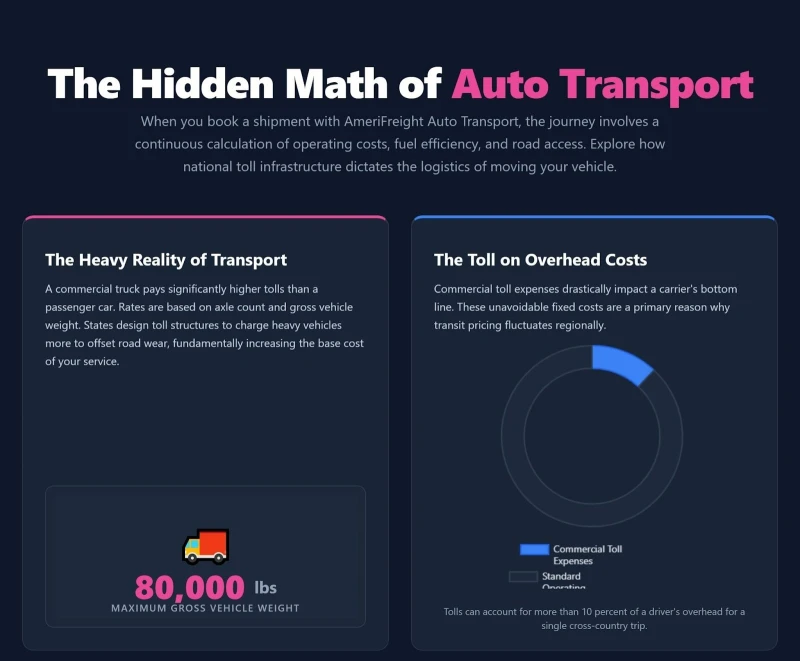
Many people assume a commercial truck pays a slightly higher toll than a passenger car. The reality is that commercial toll rates are based on axle count and gross vehicle weight. A fully loaded auto transport trailer can weigh nearly 80,000 pounds. States design their toll structures to charge these heavy vehicles significantly more to offset road wear. Commercial toll expenses can account for more than 10 percent of a driver's overhead for a single trip.
Fuel Consumption Versus Toll Road Expenses
Avoiding a toll road is not always cheaper in practice for vehicle shipping services. Secondary highways force a massive commercial vehicle to constantly accelerate and decelerate through small towns, traffic lights, and tight intersections. This stop-and-go driving drastically increases fuel consumption. A gallon of diesel burns much faster idling in local traffic than it does cruising at a steady highway speed.
Carriers must perform complex math before accepting a route. They calculate whether the fuel burned to avoid a toll exceeds the cost of the toll itself. These daily calculations are why prices fluctuate and why flexibility is required when planning a vehicle shipment.
Transit Times and Vehicle Shipping Route Choices
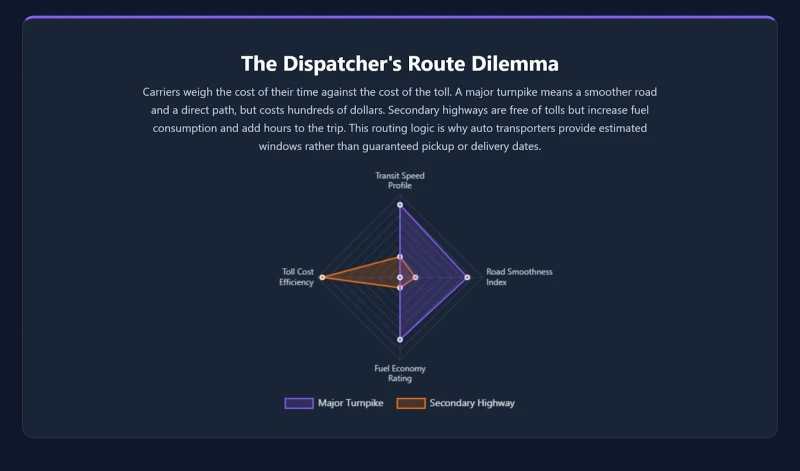
A driver moving a load of vehicles across the Northeast or the Midwest faces a difficult choice. Taking the major turnpike means a smoother road and a direct path. It also means paying hundreds of dollars in commercial tolls for a single transit. The alternative is taking those secondary state highways. These routes are free of tolls but add hours to the trip, require navigating smaller intersections, and often feature rougher pavement.
Carriers weigh the cost of their time against the cost of the toll. If the toll fee exceeds the cost of fuel and driver hours saved, the truck will take the secondary route. This routing logic is why transit times fluctuate and why auto transporters provide estimated windows rather than exact pickup or delivery dates. Traffic, weather, and the specific path a carrier must take to manage operating costs all play a role in the car shipping schedule.
Regional Toll Disparities in Car Shipping Services
The United States does not have a uniform tolling system. A route moving through the Southwest might encounter flat, open interstate for days without a single fee. Conversely, moving a vehicle up the Northeast Corridor involves a gauntlet of toll bridges, turnpikes, and tunnels. Carriers operating in states like Pennsylvania, New York, or Florida face daily operating costs that simply do not exist in other parts of the country.
This regional disparity dictates carrier availability. Drivers prefer routes that maximize their profit margin. When a customer requests a shipment through a heavy toll region, the base rate must reflect those fixed costs to attract a reliable carrier. We manage continental shipments across these diverse toll landscapes. Shipping to Alaska is not available. Shipping to Hawaii is not available. We can only coordinate delivery to a California port, where you will need to arrange further transport with trusted ocean freight shippers such as Matson.
How Toll Infrastructure Impacts Your Car Shipping Experience
Shipping a car through regions with dense toll networks naturally increases the operating cost for the carrier. We see this dynamic daily at AmeriFreight Auto Transport. When our customer service agents help coordinate your shipment, they factor in the realities of these regional infrastructure costs. We provide estimates based on current market conditions, though we do not offer exact quotes. You have the security of knowing there is no upfront payment until you choose a carrier.
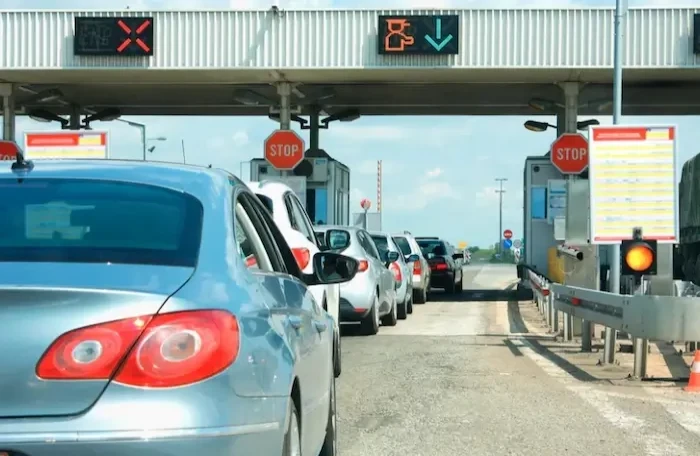
It is important to prepare your vehicle properly before it gets loaded. Remove all electronic toll collection transponders from your windshield. If a tag is left active in the car, the toll plaza gantries will often read it as the truck passes underneath. You will end up paying the toll for your own car while it sits parked on the trailer.
You must also remove all personal belongings. The Department of Transportation does not permit personal items to be shipped in vehicles. If allowed by a specific carrier, it is usually for an extra fee and must be discussed beforehand. Keep in mind that we only assist with vehicle transportation, not household goods.
Urban Congestion Fees and Door-to-Door Delivery
Major metropolitan areas are increasingly implementing congestion pricing. Entering specific urban zones now carries heavy fees for commercial vehicles. These fees compound the existing costs of long-distance tolls. When a carrier navigates into a dense city to complete a vehicle delivery, they are paying for the privilege of accessing those streets.
This is another reason we utilize Door-to-Door Service (Location Permitting). A massive carrier cannot physically or legally access every residential address, especially in cities with heavy commercial restrictions or weight limits. Meeting a driver at a nearby open plaza or shopping center often bypasses the deepest urban congestion zones and avoids unnecessary municipal fees.
Protecting Your Vehicle During Open and Enclosed Transport
Toll roads generally offer better maintenance and smoother surfaces than secondary highways. A smoother road means fewer vibrations transferred to the vehicles secured on the auto transport trailer. Whether you are using standard open transport or an enclosed carrier, road quality matters. This applies whether you are shipping a standard sedan or an electric vehicle. There are no hybrid-equipped carriers for EVs. Only standard transport options are available for these vehicles, which means they travel on traditional open or enclosed trailers.
The Reality of Modern Auto Transport Logistics
Understanding the mechanics of auto transport helps set realistic expectations. Heavy commercial trucks do not operate under the same rules or financial models as passenger vehicles. The infrastructure they use dictates how fast they can travel and how much a trip costs.
We prioritize transparency throughout this process. We focus on connecting you with reliable carriers and providing clear communication during standard business hours. As one of the best reviewed in the industry, our goal is to manage the logistical hurdles of the highway system efficiently.